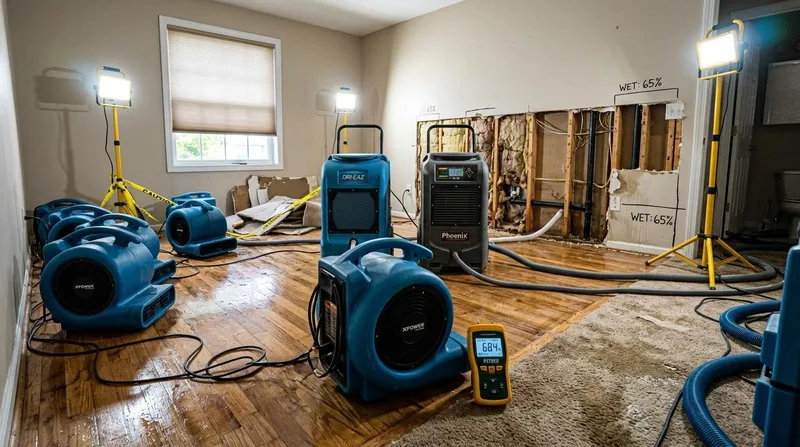
The short version
Structural drying in Dallas, TX uses air movers, dehumidifiers and moisture meters to dry framing, drywall, subfloors and slabs. No fixed time applies; the job ends when readings match dry materials. The EPA sets a target of 24 to 48 hours for drying wet areas to prevent mold.
What is structural drying in Dallas, TX?
Structural drying is the controlled removal of moisture from the parts of a building that hold a house up: framing, drywall, insulation, subfloor and slab. In Dallas, TX it follows a leak, a storm or a burst pipe, and it continues until readings show those materials are back to normal.
This site is a referral service and does no drying itself. It puts Dallas-area property owners in touch with independent restoration providers, and each one chooses its own equipment, schedule and terms. Use this page to understand the work and to judge what you are told.
Surface water is the easy part. The harder part is moisture that has soaked into materials, where a towel and a fan do not reach. That is the job structural drying exists to do, and the water damage glossary defines the terms you will meet along the way.
How long does water damage restoration take?
There is no single number, because the length depends on how much water came in, what it soaked and how humid the air is. The only firm target in the sources used here is the EPA's: get wet areas and items dry in 24 to 48 hours to head off mold. Full repairs run longer.
Think of the job in two parts: drying first, which ends when moisture readings say so and not on a calendar date, then repair, which covers drywall, flooring and paint.
Insurance runs on its own clock. After the February 2021 freeze, the Texas Department of Insurance reported an average of 61.4 days to close a residential claim, which measures paperwork and not repairs. The insurance claims guide covers it.
What are the stages of a structural drying job?
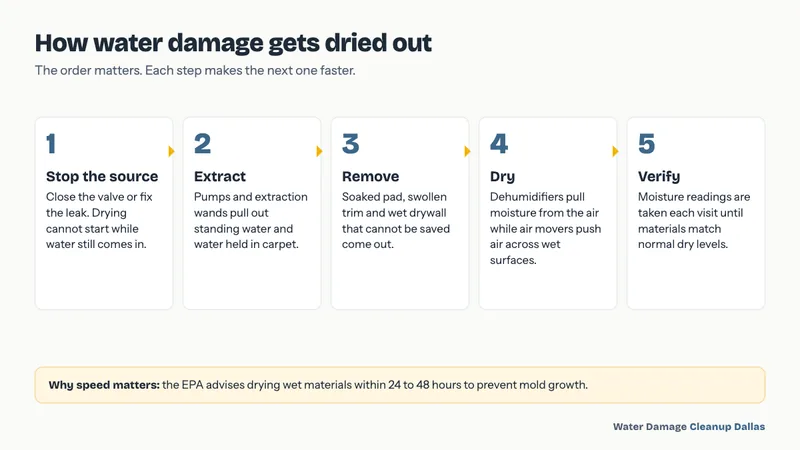
A drying job runs in a set order: find and stop the water, remove what is standing, take out anything that cannot dry, set equipment, then measure until the readings come down. Each stage needs the one before it, so skipping ahead tends to leave wet pockets behind.
- Find the extent. A moisture meter, and sometimes a thermal camera, shows where water has traveled beyond the visible stain.
- Remove the water. Extraction comes first, since standing water slows everything else. See water removal and extraction.
- Take out what will not dry. Pad, soaked insulation and swollen drywall are the usual candidates.
- Place equipment. Air movers and dehumidifiers are set so air crosses every wet surface.
- Check and adjust. Readings are taken at each visit and equipment is moved to the spots still wet.
- Confirm dry. Equipment comes out when readings match those of unaffected materials in the same house.
The wider picture is on the water mitigation page, which also covers what to do in the first two days.
What equipment is used to dry a structure?
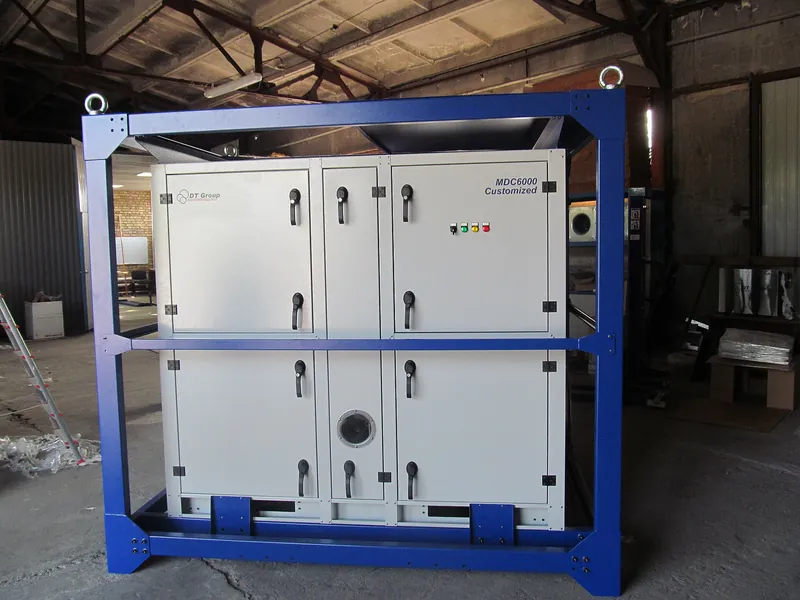
Three kinds of equipment do most of the work: air movers that push air across wet surfaces, dehumidifiers that pull the moisture out of that air, and meters that measure what is left in the materials. Some jobs add drying panels for floors or hoses that push air into wall cavities.
| Equipment | What it does | What to watch for |
|---|---|---|
| Air movers | Speed evaporation from walls, floors and ceilings | Noise, and a house that feels warmer |
| Dehumidifiers | Remove moisture from the air so drying continues | Doors and windows kept shut while they run |
| Moisture meters | Show how wet framing, drywall and subfloor are | Readings written down at every visit |
| Thermal camera | Hints at where water is hiding behind finishes | A guide only; meters confirm it |

Air movers without dehumidification just move moisture around the house. If you see fans running with no dehumidifier in the building, ask why.
How do you know a structure is really dry?
You know it from numbers, not from touch. A provider compares readings in the wet area with readings from the same material in a part of the house the water never reached, and equipment stays until the two match. Dry-feeling drywall can still be holding water inside.
Ask for the log. A good drying log lists the date, the spots measured, the readings and the equipment placed on each visit. Your insurer may ask for it, and it is your evidence that the work was finished before walls were closed.
- Readings should fall from one visit to the next. A number that stalls points to a wet pocket or a source still leaking.
- Readings should be taken in the same spots each time so the comparison is fair.
- The provider should say what reading counts as dry for each material, and why.
Which parts of a Dallas house are hardest to dry?
The slow spots are wall cavities, insulation, the subfloor and the slab. They hold water out of sight and have little airflow. A ceiling stain from an attic leak or AC overflow can mean wet insulation above and wet drywall below, with the framing between them also taking on water.
| Area | Why it dries slowly | Common approach |
|---|---|---|
| Wall cavities | Closed space with little airflow | Holes or removed baseboards to move air through |
| Attic insulation | It soaks up water and holds it | Wet sections removed |
| Subfloor | Sits under flooring and pad | Flooring lifted, or drying panels used |
| Concrete slab | Dense, so it gives up water slowly | Flooring removed, dehumidifiers kept running |
If the stain came from the roof, see roof leak water damage. If it came from the air conditioner, the AC leak page shows where the water travels.
Do walls and floors have to be opened up to dry?
Sometimes, and the reason is access to the water. Wet insulation and drywall that touched contaminated water have to come out. In a clean-water leak, a small hole or a removed baseboard may be enough to let air into the cavity, and the rest of the wall can stay in place.
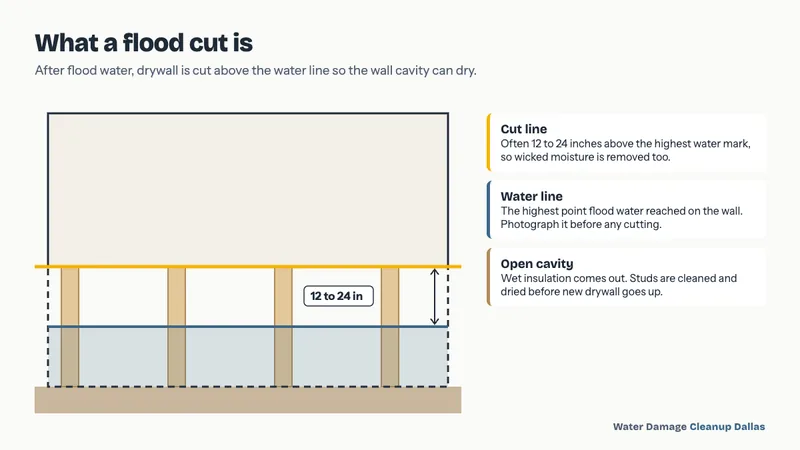
The decision should rest on readings, and you should be shown them. For water that came in from outside, the IICRC S500 standard puts it in its worst category, and porous materials it reached usually come out rather than dry. Details are on the flood cleanup page.
Ask any provider to show you the wet area on the meter before cutting, and to explain which cuts are needed and which are a choice.
Can a concrete slab be dried?
Yes, though slowly. Concrete is dense and gives up water at its own pace, so a slab under flooring can need days of dehumidification before new flooring goes down. Putting flooring over a slab that still holds water can trap moisture and bring the problem back.
If your house sits on a slab, a supply line leaking beneath it or water from outside can wet the flooring from below. Signs include a warm patch on the floor, the sound of running water with fixtures off, or flooring that stays damp for no visible reason. The slab leak page covers those signs, and water-damaged floor repair covers what goes on top.
Does Dallas humidity make drying harder?
It can. The National Weather Service gives DFW Airport a normal annual relative humidity of 66 percent, and an average of 82 percent at 6 am. Damp air takes up less moisture, so a house with the windows open on a humid morning can dry slower than one kept closed with dehumidifiers running.
For indoor air, EPA guidance is to stay below 60 percent humidity, with 30 to 50 percent as the goal. Dallas summers also run hot, and the NWS lists 20.2 days a year at or above 100 F, so air conditioning is usually working hard while drying equipment adds heat.
Ask a provider how they will control the indoor air, and whether the air conditioner should stay on. If water reached the air handler or ducts, leave the system off until someone has inspected it.
Can you dry a house yourself with fans and a rented dehumidifier?
For a small clean-water spill on a hard floor, yes. For anything that reached carpet pad, drywall, insulation or a subfloor, fans and a rented dehumidifier cannot show you what is left inside the materials. Without a meter you are guessing, and a wrong guess ends in mold or warped floors.
- Extract or mop up standing water first; a dehumidifier cannot handle a flooded floor.
- Run the dehumidifier in a closed room and empty it often, or drain it to a sink or outside.
- Keep checking hidden spots, such as the bottom of walls and under cabinets, for dampness.
- Do not aim a space heater at wet wood; fast heat can crack and warp it.
If any wet area is bigger than you can dry in the first day or two, treat it as a job for a provider. The emergency water damage page lists the order of steps.
What happens if drying stops too early?
Water stays in the materials and mold can start. Mold needs moisture, and the EPA and CDC both point to the first 24 to 48 hours as the window for drying wet areas. Closing walls over wet framing is one of the most common ways mold ends up hidden.
The CDC lists stuffy nose, sore throat, coughing, wheezing and burning eyes among the effects of mold, with stronger reactions possible for people with asthma or a mold allergy. If mold has already appeared, read mold after water damage.
Texas regulates mold work above a size. The Texas Department of Licensing and Regulation says that in most instances visible mold under 25 contiguous square feet can be cleaned by unlicensed people. For a larger area, check the rules before hiring anyone.
How much does structural drying cost?
Prices depend on the size of the area, the number of days equipment runs and what has to be removed, and each provider sets its own. For a national reference, Fixr puts water damage restoration at $1,200 to $5,000, averaging $3,000. That is not a Dallas quote.
Fixr also gives flat ranges by damage class: $150 to $400 for Class 1, $500 to $1,000 for Class 2 and $1,000 to $3,000 for Class 3. Restoration per square foot runs from $1.50 to $3 for drywall to $10 to $15 for hardwood.
Ask whether equipment is charged per day or per job, and what happens to the price if readings stay high. The restoration cost guide explains how the line items add up.
What should you ask a drying provider?
Ask how they will show the structure is dry, how many days they expect equipment to run, what they plan to open up, and who pays if readings stay high. Providers differ on every one of these, so confirm directly and get the answers in writing.
- Will you give me the moisture readings and the drying log?
- What counts as dry for each material?
- How is the equipment priced, and what could extend it?
- Which materials will you cut out, and can I see the meter reading first?
Before signing, read the work authorization guide. The guide to choosing a restoration company adds more questions.
Sources: EPA mold and moisture brief guide; IICRC S500 water categories; CDC mold and health; NWS Fort Worth/Dallas, DFW Records and Normals; TDI, Winter Storm Uri losses report; TDLR mold FAQ; Fixr cost ranges.