For Grand Prairie homeowners
With water damage restoration in Grand Prairie, TX, the first moves are closing the water valve, taking photos and starting to dry in the first 24 to 48 hours. Standard homeowners policies leave out flood water. Requests are taken for Grand Prairie addresses.
Which Grand Prairie addresses do you take requests from?
For water damage restoration in Grand Prairie, TX, requests come in from the home ZIP codes 75050, 75051, 75052 and 75054. Addresses tied to PO box ZIP 75053 are on the list too. When a provider calls back, ask whether your street is in their range, since drive distance and schedules vary by company.
Grand Prairie sits between Dallas and Arlington, so some streets are closer to a neighboring page. Read about Irving and Coppell, Arlington and Mansfield or Oak Cliff if your address is near one of those edges.
Where does Grand Prairie sit, and why does it matter for a leak?
It sits on the west side of Dallas County, with parts in Tarrant County. Wikipedia's Cedar Hill article says Grand Prairie lies to the southwest, west and northwest of Cedar Hill, and its Arlington article lists Grand Prairie as a neighbor.
The ground is not flat everywhere. Wikipedia's Dallas article describes the White Rock Escarpment, a limestone rise of 230 feet, and says the uplift south of the Trinity River is noticeable in Grand Prairie, Cedar Hill, Irving and Oak Cliff.
Slope changes where rain goes. Look at which way your lot and street fall, and where a downspout sends its water. Check your water bill to see which utility serves you, since a county line can change who answers a street-side problem.
If your house sits on a slab, there is little space under the floor, so a slow leak spreads sideways through flooring and baseboards. Walk the perimeter after heavy rain and look for damp trim, soft baseboard and doors that have started to stick.
Does Grand Prairie flood?
Wikipedia does not describe flooding inside Grand Prairie, so this page makes no claim about your street. It does describe a big piece of local water engineering. Joe Pool Lake covers parts of Tarrant, Dallas and Ellis counties and was built partly to deliver flood control to property owners in the Mountain Creek and Walnut Creek watershed.
The lake holds 7,740 acres of water and drains an area of 232 square miles, per Wikipedia. It drains north into Mountain Creek, which sits in the Upper Trinity River Basin and has a 304-square-mile watershed. The article's reference list also includes a City of Grand Prairie page on Lynn Creek Park, a lakeside park.
A reservoir cannot stop a downpour from filling a street. Water that enters from outside is Category 3 under IICRC S500, and Triple-I says standard homeowners policies exclude flood. Our flood zone guide shows how to check an address.
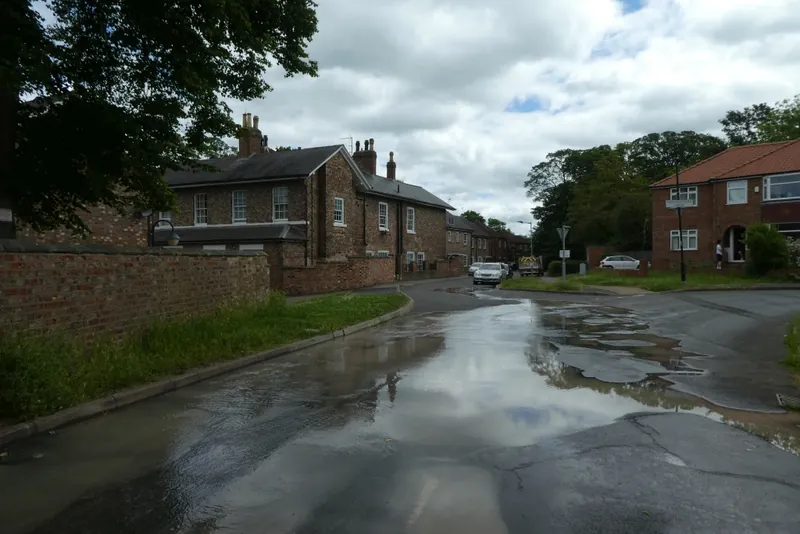

What have North Texas storms done to houses like mine?
They have shown three ways water gets in: through the roof, through the doors, and through pipes that freeze. The National Weather Service Fort Worth office and Triple-I record each of them. The table pairs the record with the first place to look in a Grand Prairie house.
| Event | What the source recorded | How water gets in | Look first |
|---|---|---|---|
| Mayfest hail, May 5, 1995 | Softball-size hail on Tarrant and Dallas counties, about $2 billion in damage | Broken roof layers, cracked windows | Ceilings and attic decking |
| Same storm, flash flooding | Rain rates near 2.25 inches in 15 minutes over Dallas County | Runoff at doors and low streets | Garage and door thresholds |
| February 2021 freeze | 139 straight hours at or below freezing at DFW Airport | Split supply lines, then a thaw | Attic, garage and exterior walls |
| Hail in 2025 | Texas ranked first with 902 major hail events | Hidden roof damage | Ceiling stains after rain |
Sources are the NWS Mayfest Storm page, the NWS February 2021 page and Triple-I hail statistics.
Can hail cause a leak that shows up weeks later?
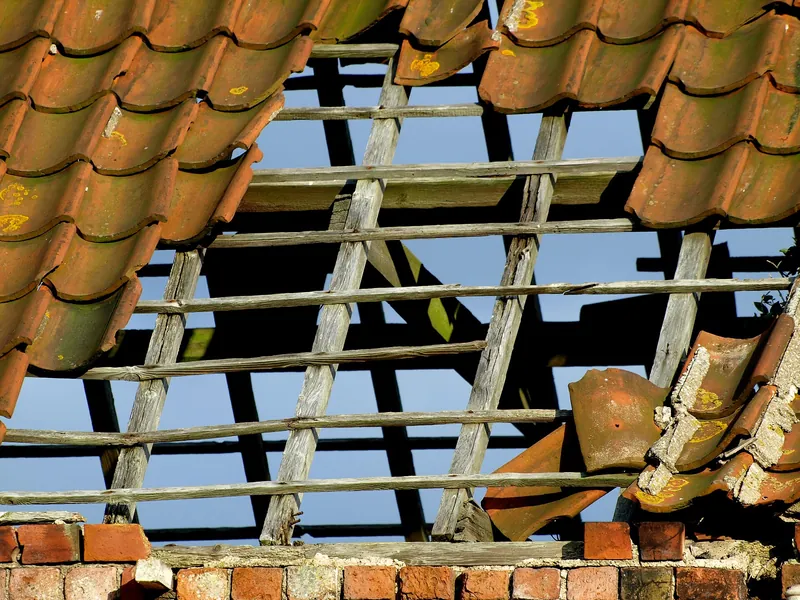
Yes. Hail can bruise or crack roofing without making a hole, and water finds the damage on the next hard rain, often far from the point of impact. Triple-I counted 5,432 US hail events in 2025, and 902 of the major ones were in Texas.
After a storm, walk the yard for granules in the gutters and dents on vents, then check the attic with a flashlight. Photograph what you find before anyone climbs up to repair it. A stain that grows after rain points to the roof, and one that grows on dry days points to plumbing.
- Look at the underside of the roof deck for dark streaks or damp insulation.
- Check ceilings below bathrooms, since vent boots crack in hail too.
- Keep a log of dates when stains appear, which helps with a claim.
Read roof leaks after storms and hail and hidden roof leaks before you decide what to do.

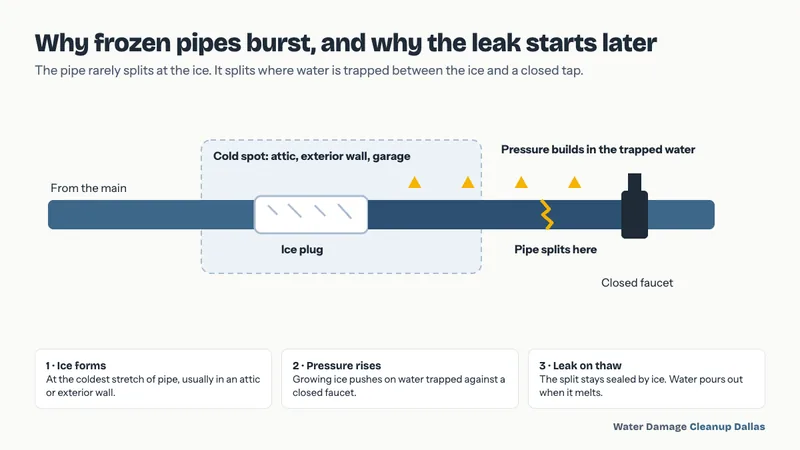
Can a hard freeze burst pipes in a Grand Prairie house?
Yes. In February 2021 the NWS says DFW Airport spent 139 consecutive hours at or below freezing, and the low there reached -2 F on February 16. Pipes in attics, garages and exterior walls are the usual weak spots, because those spaces sit outside the heated part of the house.
The American Red Cross names attics, garages and kitchen cabinets as high-risk spots for supply pipes. For a trip in cold weather it suggests a thermostat set to at least 55 F, plus a slow drip from any faucet fed by exposed pipe.
Learn where your main shutoff is before the next hard freeze. If a pipe has split, close the house valve and phone a plumber before anything else. The 2021 storm page and frozen pipe prevention guide cover the details.
What if the leak comes from an attic water heater or air conditioner?
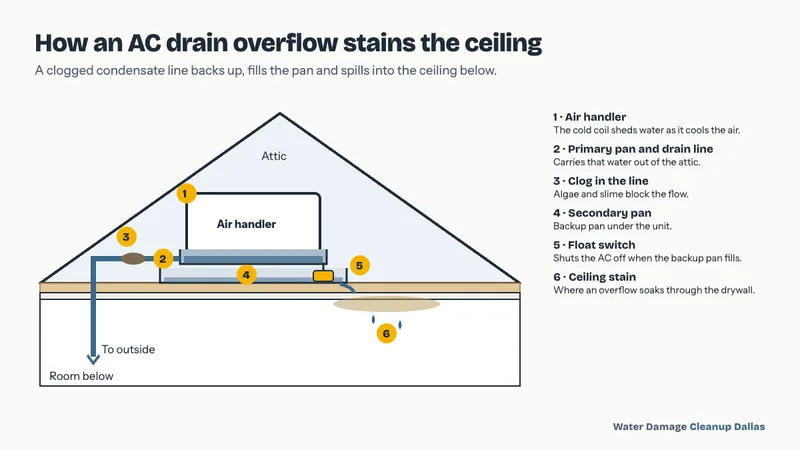
Treat a ceiling stain on a dry day as a plumbing or equipment clue. If your water heater or air handler is in the attic, a small drip can soak insulation and ceiling drywall before anyone sees it. Find out where yours sit instead of guessing.
The summer case is a clogged condensate drain line. The pan fills, overflows and the water drops through the ceiling below. A float switch can shut the unit off before that happens, and a technician can tell you whether yours works.
- Turn off the air conditioner at the thermostat if you see water at the unit.
- Shut off the water heater supply valve if its pan or lines are wet.
- Put a bucket under the lowest point of a bulging ceiling.
- Photograph everything, then call a plumber or HVAC technician.
The AC leak guide and water heater leak page go step by step.
What if the water is sewage or a heavy-rain backup?
Treat it as a different job from a clean supply-line leak. For sewage or other contaminated water, the EPA tells homeowners to bring in a professional who has worked on buildings with that kind of damage. Children and pets should stay out of the room, and a fan and a mop are not enough.
In a slab house the lowest drain is usually a floor drain, a shower or a tub, and that is where a backed-up line tends to surface. IICRC S500 puts sewage and rising outside flood water in Category 3, the most contaminated class.
The EPA adds that moldy surfaces should never be painted or caulked. Photograph soaked carpet and drywall before anything leaves the house, because your insurer may want to see it. The sewage backup page and the sewage exposure guide explain what to wear and what to avoid.
Will insurance pay for water damage in Grand Prairie?
Burst plumbing or a roof leak is often covered, while flood water is not. The NAIC describes plumbing and roof-leak water damage as typically covered and ground water or rain runoff as typically excluded. Policy wording differs, so read yours and call your agent.
A sewer backup is a gap, according to Triple-I: a typical homeowners policy leaves it out, and so does flood insurance, so it takes a separate product or endorsement. Neglected upkeep, such as worn flashing, is also excluded.
Phone your insurer before you sign any work order, and keep every receipt. The Texas Department of Insurance lays out the claim steps, including its rule that a rejection must come with a written reason. See how water damage claims work.
What should I do in the first 24 to 48 hours?
Stop the source first, keep people safe, and begin drying quickly. The EPA puts the mold-prevention window at 24 to 48 hours for water-damaged areas and items. Soaked drywall, pad and insulation stay wet inside long after they feel dry to the touch.
- Close the main water valve, and cut power to wet rooms only if that is safe.
- Record video and photos of every wet surface before moving furniture.
- Tell your insurer what happened and ask what they want to see first.
- Ask a restoration provider which moisture readings they will take and keep.
- Aim for indoor humidity under 60 percent; the EPA calls 30 to 50 percent ideal.
A longer checklist sits on the emergency page, and water removal covers the work after the source is stopped. If a pipe or fixture failed, the burst pipe guide helps you sort out what to photograph.
Sources: Joe Pool Lake, Dallas, Arlington, Texas and Cedar Hill, Texas (Wikipedia); NWS Fort Worth/Dallas, Mayfest Storm; NWS, February 2021 winter event; Triple-I, hail; Triple-I, disasters covered by homeowners insurance; NAIC homeowners insurance; Texas Department of Insurance, getting your claim paid; IICRC S500; EPA, A Brief Guide to Mold, Moisture and Your Home; American Red Cross, frozen pipes.