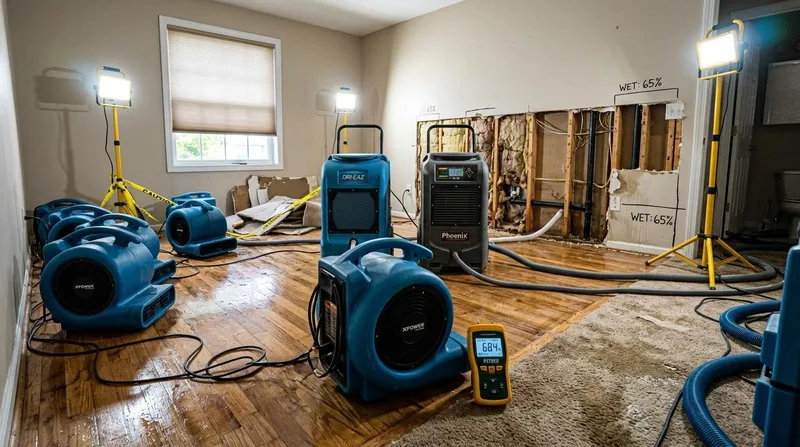
The short version
Water damage repair in Dallas begins after the structure is dry, because rebuilding over wet framing hides the problem. Soaked drywall, insulation and flooring are usually replaced, and solid materials are often saved. Get written bids, document everything, and ask each provider whether it does rebuild work.
What does water damage repair in Dallas actually include?
Repair is the rebuild that comes after the house is dry. Wet drywall, insulation, trim, cabinets and flooring that could not be saved get replaced, then the surfaces are patched, primed and painted. Water damage repair in Dallas starts only once a moisture meter says the framing has dried out.
That order matters because closing up a wet wall hides a problem instead of fixing it. The drying and tear-out stage is covered in the structural drying guide and the water mitigation guide. This page picks up where they stop.
This site is a referral service, not a contractor. It connects callers with independent restoration providers, and providers differ on whether they also do rebuild work.
Who handles the repair after a Dallas water loss?
Often more than one company. A restoration provider commonly pulls out the water, removes ruined materials and dries the structure. The rebuild may come from that same provider, from a general contractor, or from separate trades such as a drywall finisher, a flooring installer and a painter.
Do not assume one phone call covers everything. Put these questions to each company before you agree to anything.
- Do you do the rebuild, or only the drying and demolition?
- If you subcontract, who are the subcontractors and who answers for their work?
- Will the estimate list drying, demolition and rebuild as separate lines?
- What do you need from me, and from my insurer, before work begins?
- Can I see the written scope before I sign a work authorization?
The guide to choosing a restoration company has the full call list, and the work authorization guide explains what the paperwork should say. Nothing here means a particular provider offers rebuild work, so confirm it directly.
What are the steps from a wet house to a finished repair?
The job runs from stopping the source to final paint, and the repair stage comes last. The order is roughly the same everywhere even though crews divide the work differently. Each step protects either the structure or your insurance claim.
- Stop the source. A plumber fixes the pipe, a roofer covers the roof, or the leaking appliance gets shut off.
- Document first. Photograph and film the damage before anything is moved or thrown out.
- Remove the water. Standing water goes first, then wet materials that cannot be dried.
- Dry the structure. Air movers and dehumidifiers run until readings match dry reference materials.
- Get the scope in writing. The rebuild plan, materials and prices are listed line by line.
- Rebuild. Drywall, insulation, flooring, trim and paint go back in.
- Walk the job. Check each room before final payment.
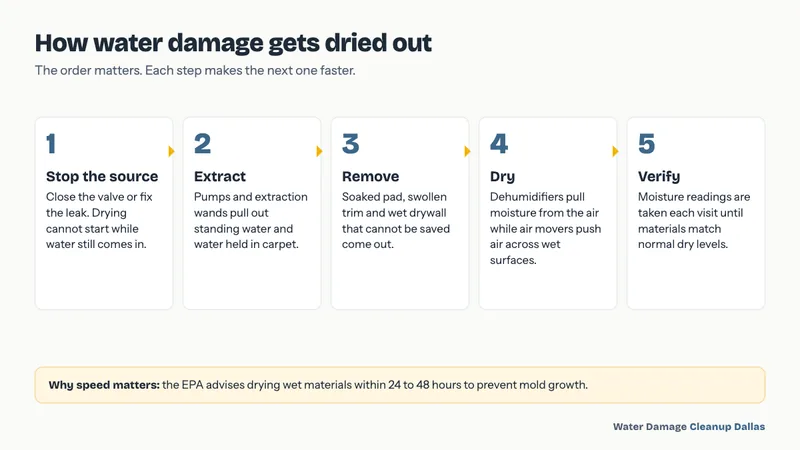
Skipping the monitoring step is the common mistake. A wall can feel dry to the hand and still hold moisture in the cavity.
How soon can repairs start after water damage?
As soon as the materials are dry and your insurer has seen the loss. For mold prevention, the EPA sets a target of 24 to 48 hours to get wet areas and belongings dry. That target is about drying, though, and the rebuild itself follows once readings come down.
Triple-I tells policyholders to limit further harm with reasonable steps, yet to wait on big permanent fixes until an adjuster has seen the loss. Its advice on ruined items is to keep them in the meantime.
So the sequence for most claims is: protect, document, let the adjuster look, dry, then rebuild. If you must start before an inspection can happen, tell the insurer and the provider, and keep the old materials or detailed photos. The insurance claims guide walks through the timing.
Which damaged materials get repaired and which get replaced?
Porous, soaked materials are usually replaced, while hard and solid ones are often cleaned and dried. The water category changes the answer. The IICRC S500 puts clean supply-line water in Category 1 and rising flood water or outside surface water in Category 3.
The table is a rough guide for water that came from a broken supply line. The final call belongs to the provider with a moisture meter in hand.
| Material | Often repaired | Often replaced | More detail |
|---|---|---|---|
| Drywall | Surface-damp panels that dry fast | Soft, sagging or stained-through panels | Drywall guide |
| Hardwood and laminate | Boards dried before they warp | Cupped, buckled or swollen planks | Floor guide |
| Carpet and pad | Carpet after clean water, if dried fast | Pad, and carpet soaked by outside water | Wet carpet guide |
| Ceilings and insulation | Small stains once the source is fixed | Saturated insulation and sagging drywall | Ceiling guide |
| Cabinets and trim | Solid wood that dries flat | Swollen particleboard boxes and baseboard | Kitchen and bath guide |
| Tile and concrete slab | Usually cleaned and dried | Cracked tile or loose grout lines | Slab leak guide |
Outside flood water is different. For contaminated water the EPA points to a professional with experience in that kind of building damage, and the flood cleanup guide shows how those jobs run.
How much does water damage repair cost in Dallas?
This site has no Dallas price list and does not quote what any provider will charge, but national cost guides give a sense of scale. Fixr's guide runs from $1,200 to $5,000 for whole-job restoration, averaging $3,000 nationally. Bob Vila's range is $1,305 to $5,707, with a $3,455 average.
Both guides break the work down by material, and the per-square-foot figures show why the material list matters more than the headline number.
- Fixr lists drywall at $1.50 to $3 per square foot and carpeting at $4.75 to $10.50.
- The same Fixr page gives hardwood at $10 to $15 per square foot and plaster at $6.25 to $18.75.
- Bob Vila gives ceiling repair at $350 to $1,250 and floors at $200 to $500 to restore.
- The Insurance Information Institute reports an average homeowners claim for water damage and freezing of $15,400 across 2019 to 2023.
Treat these as national ballparks. Get bids on paper that itemize materials and prices, and read the restoration cost guide for what drives the spread.
Does insurance pay for water damage repair in Texas?
Mostly the source of the water decides. According to the NAIC, a plumbing failure or a leaking roof is the usual covered case, and ground water, runoff and snow-melt are the usual exclusions. FEMA notes that flooding is outside most homeowners policies.
- Plumbing, appliances and AC lines: Standard forms, per Triple-I, name sudden overflow or discharge from plumbing, heating, cooling and household appliances.
- Mold: Mold cost is often excluded, the NAIC says, and Triple-I lists mold, neglected maintenance and pests as things a policy will not pay for.
- Sewer backup: Triple-I reports that neither a typical homeowners policy nor flood insurance pays for it, so it takes a separate endorsement.
On timing, the Texas Department of Insurance lays out a claim clock. Acknowledgment is due in 15 business days, and the decision is due 15 business days after the company has what it asked for. A 45-day extension is possible with an explanation, payment follows in five business days once agreed, and a denial must come with written reasons.
Your policy and the adjuster decide coverage, not this page. The insurance claims guide and the loss of use coverage guide cover the rest.
Why do Dallas homes need water damage repair so often?
North Texas weather is hard on roofs, pipes and slabs. Texas ranked first in the country with 902 major hail events in 2025, according to Triple-I, citing NOAA's Storm Prediction Center. Hail opens roofs, and rain follows through the gap into the attic and ceiling.
Cold is the other driver. The National Weather Service says DFW Airport spent 139 consecutive hours at or below freezing in February 2021, and burst pipes were among the damage the Texas Department of Insurance reported statewide. The winter storm 2021 guide covers that event.
Summer has its own leak. Supply pipes in attics, garages and kitchen cabinets are the ones most exposed, the Red Cross says, and attic air handlers can overflow a clogged drain line onto the ceiling below. Most North Texas houses sit on concrete slabs, so water often spreads across floors and up the base of walls instead of draining down.
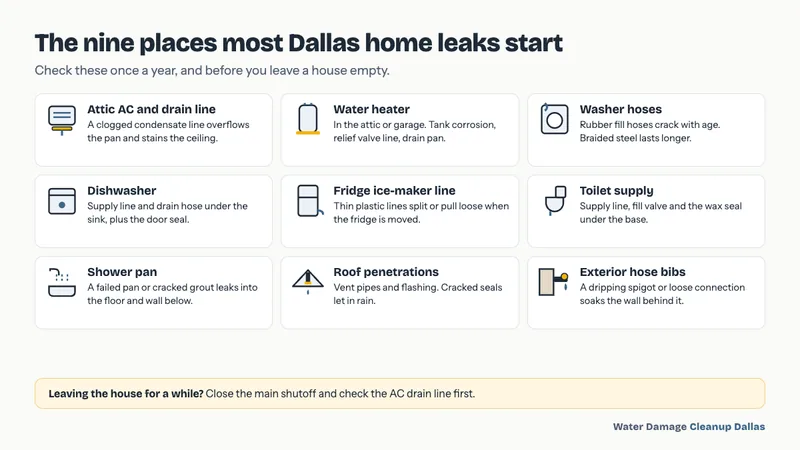
For a sense of local rain, the NWS normals for DFW Airport show 37.01 inches of precipitation a year and an average of 46.5 days with thunderstorms.
What should you do before any repair starts?
Protect the house, document the damage and keep every record. A repair estimate is only as good as the evidence behind it, and an adjuster may ask to see the damage as it was before anything was torn out or thrown away.
- Shut off the water at the house valve if a supply line is the source. The water meter leak test guide helps when the source is unclear.
- Photograph and film every room, with close-ups of the water line on walls.
- Hold on to damaged items until the adjuster has looked at them.
- Save every receipt for tarps, fans, hotel stays and temporary fixes.
- Call your insurer and ask what documents it needs.
- Request a provider for the water and drying, then ask about the rebuild.
Mold can show up if materials stay wet. The EPA wants indoor humidity under 60 percent, ideally 30 to 50 percent, and says moldy surfaces should not be painted or caulked. The mold guide sorts what to do yourself from what needs a professional.
Does mold change the repair plan?
Yes, because moldy materials need cleaning or removal before anything new goes on top. Per the CDC, mold exposure can bring on coughing, wheezing, sore throat, burning eyes or a rash, and people with asthma or a mold allergy may react badly.
Texas regulates mold work. The Texas Department of Licensing and Regulation says licensed mold assessors and remediators are governed by Occupations Code Chapter 1958, and that visible mold under 25 contiguous square feet can in most instances be cleaned by unlicensed people. TDLR adds that a firm can hold both license types, yet may not assess and remediate the same project.
That last rule is a useful test. If a company offers to test for mold and also remove it, ask how it handles the conflict. TDLR does not do assessments or remediation itself and cannot force a landlord to remove mold.


How do you pick a contractor for the rebuild?
Get written bids from more than one company and compare them line by line. Triple-I recommends written bids from licensed contractors, with materials and prices itemized. Compare scope, not just the total, because a low number often leaves out drying or finish work.
- Check that drying and rebuild are separate lines, so you can tell what each costs.
- Confirm who pulls permits if the work needs them, and ask your city what it requires.
- Ask which brands and grades of materials are in the bid.
- Be wary of anyone asking for most of the money before work begins.
- Keep every signed paper and a copy of the final walkthrough.
If you disagree with your insurer's number, Triple-I notes that many policies allow an independent appraisal, and a public adjuster's fee can reach 15 percent of the settlement. The CLUE report guide explains how water claims show up on a property record.
How does this site connect you with a provider?
You send a request through the site, and it passes your details to an independent restoration provider that takes requests for your area. The site is not a restoration company and does not set prices, schedules or scope for any provider.
Say what happened, which rooms are wet and whether the source is stopped. Mention that you also need rebuild work if you do, so the provider can say up front whether it offers that. The contact page has the details, and the editorial policy explains how pages here are written and sourced.
If you only need an idea of the next step, start with the emergency water damage restoration page, or browse the water damage guides.
Sources: TDI claim payment steps; TDI Winter Storm Uri report; TDLR mold FAQ; TDLR mold program summary; Triple-I on settling claims; Triple-I on covered disasters; Triple-I homeowners statistics; NAIC homeowners insurance page; FEMA flood insurance FAQ; Fixr restoration cost guide; Bob Vila restoration cost article; Triple-I hail statistics; NWS Fort Worth on the February 2021 storm; NWS Fort Worth DFW normals; Red Cross frozen pipes page; EPA brief guide to mold and moisture; EPA guidance on cleaning up mold; CDC page on mold and health; IICRC S500 water categories.