The short version
To choose among water damage restoration companies in Dallas, compare at least two on scope, drying proof, credentials and billing. Verify licenses with the agency that issued them, read reviews for patterns, and read the work authorization before you sign.
How do you choose among water damage restoration companies in Dallas?
Compare at least two companies on the same few points: what they will remove, how they prove the drying is finished, what credentials their crew holds and how they bill. Water damage restoration companies in Dallas differ on every one of those, so the answers matter more than the ad copy.
- Stop the source first. No company can dry a house with a pipe still leaking.
- Call more than one company if the water is no longer rising and you can spare an hour.
- Ask for a written scope and price before any equipment comes off the truck.
- Verify what they tell you: licenses with the issuing agency, reviews on more than one site.
- Phone your insurer before anything is thrown out or torn out.
This site is a referral service. It does not rate or rank providers, and it cannot vouch for any one of them. The rest of this page is the checklist to run yourself, whether you found a company through us, through a search or through a neighbor. For the emergency side, see emergency water damage help.
Can you trust online reviews and ratings for a restoration company?
Use them as a screen, not a verdict. A restoration job is a one-time event, so most reviews come from people on their worst week, and a few strong posts can sway a rating. Read the pattern across several sites and weigh the details in each review more than the star count.
- Look for specifics. A review that names the room, the equipment and what happened afterward beats a one-line rave.
- Read the three-star and one-star reviews for how the company handled a problem, not just that one occurred.
- Check the dates. Staff and ownership change, so old praise says little about the next job.
- Search the company name with the word complaints and look at what comes up beyond its own pages.
- Notice how the company replies. Calm, specific answers say more than defensive ones.

When a company has no reviews at all, it may simply be new. Ask for the names of recent customers who agree to talk, and decide whether that is enough for the size of your job.
Does a water damage company need a license in Dallas?
It depends on the work. Mold assessment and mold remediation require a license from the Texas Department of Licensing and Regulation, TDLR. This page could not confirm a single state license that covers all water damage work, so ask each company which licenses it holds and verify them with the agency that issued them.
Water removal and drying are only part of what a restoration firm may do. If the job also includes plumbing, electrical work or structural rebuilding, those trades have their own rules. Triple-I tells claimants to collect written bids from licensed contractors that itemize materials and prices. A company that cannot say who holds which license is telling you something.
For plumbing, a burst pipe or a slab leak needs a plumber before anyone can dry the house. Restoration providers and plumbers are different businesses with different credentials.
Does mold work need a separate licensed company in Texas?
Often it does. TDLR licenses mold assessors and mold remediators under Occupations Code Chapter 1958 and 16 TAC Chapter 78. One firm can hold both licenses, yet TDLR's FAQ says it cannot perform the assessment and the remediation on a single project. Small projects are exempt, so read the details.
| Situation | What TDLR says | What to do |
|---|---|---|
| Visible mold under 25 contiguous square feet | Projects under 25 square feet are exempt; unlicensed people can usually clean visible mold this small | Fix the moisture first, and ask if you are unsure |
| Larger mold projects | A licensed remediator works from a protocol written by a licensed assessor | Hire the assessor and the remediator separately |
| After the work is finished | The assessor gives the owner a certificate of mold remediation within 10 days | Keep it with your records, because sellers must pass them on |
A licensed remediator must notify TDLR at least five days before a project starts, and the assessor writes a protocol at least one calendar day before work begins. TDLR does not do assessments or remediation itself, and it cannot force a landlord to remove mold. Its mold program FAQ has the exemptions in full, and our mold guide covers the homeowner side.
What does IICRC training mean, and how can you check it?
The IICRC publishes the S500 standard for professional water damage restoration, including the water categories providers use to decide what can be saved. A company that says its crew follows S500 should be able to say which of its people hold IICRC training, and show you the proof.
The S500 sorts water into three categories. Category 1 means clean supply water, such as a burst pipe. Category 2 means gray water from a washer, a dishwasher or a toilet that overflowed without waste. Category 3 means grossly contaminated water, including sewage, river or stream flood water and surface water from outside.
Ask the company which category it thinks your water is and why. Their answer shows whether they looked at the source or just at the stain. A provider who says all water is the same, or who offers to dry sewage the way it dries a supply leak, is not following the standard. For the standard itself, see IICRC S500.
What questions should you ask on the first call?
Ask what they will do first, who will do it, how they will measure progress and how you will be billed. These questions work on any company and take about five minutes. Write the answers down, and compare them when the next company calls back.
- What will you do when you arrive, and in what order?
- Which of your people hold IICRC training, and can you show me?
- How will you record moisture readings, and will I get copies at every visit?
- Which materials will you tear out, and which will you dry where they are?
- How is the job billed: insurance price list, hourly rate or fixed quote?
- What do I owe if my insurer denies the claim?
- Who handles the rebuild, you or a separate contractor?
Providers differ on all of these. Confirm each answer directly with the company that will do the work, because this site cannot answer for them.
How should you compare two estimates?
Compare scope before price. Two quotes can differ by a wide margin because one covers a flood cut and drying equipment for several days while the other covers a fan and a dehumidifier for a weekend. Line them up item by item, and ask each company to explain any gap.
| Line item | Ask | Worry if |
|---|---|---|
| Extraction | What area, what equipment, which water category? | It is one lump sum with no scope |
| Drying equipment | How many units and for how many days? | The count cannot be explained from the room sizes |
| Demolition | Which materials come out, and why? | Everything comes out before any readings are taken |
| Monitoring | Are readings recorded and shared? | There are no visits after equipment is set |
| Rebuild | Is it included, or quoted separately? | It is bundled in with no detail |
Fixr's national price guide (updated January 31, 2025) shows restoration jobs from $1,200 to $5,000, averaging $3,000. Treat that as a rough scale only, since it is not a Dallas quote. The cost guide breaks the pieces down further.
What should a work authorization say before you sign it?
A work authorization should state the scope, the price or the method of pricing, who pays and what happens if the insurer does not. Read it before you sign, even in an emergency, and do not sign a form with blank lines. Take a photo of the signed copy.
- The address, the date and the water source as the company understands it
- What work is authorized now, and what needs your approval later
- How the bill is calculated and when payment is due
- Whether the company asks to bill your insurer directly, and what you owe if it refuses
- Who is responsible for property damage during the work
Per Triple-I, permanent repairs of any size should wait for the adjuster's assessment, and every receipt for emergency protection is worth saving. Our work authorization guide covers the clauses that cause the most trouble.
How can you tell the drying was done properly?
Ask for moisture readings taken at the start and at each visit, and compare wet areas with an untouched wall of the same material. A job is finished when the readings match, not when the surface feels dry. The EPA's target for stopping mold is 24 to 48 hours of drying from the time things get wet.
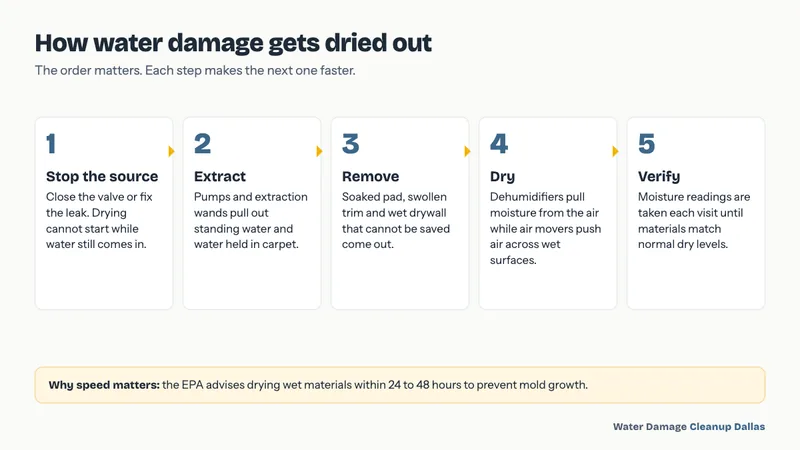
Ask to keep copies of the logs, the equipment list and the photos, since they also support an insurance claim. If a company will not share its readings, or removes equipment without final numbers, treat that as a reason to call someone else. See structural drying for how the measurements work.
Who else might call you after a loss, and what should you check?
Several parties may contact you, including your insurer's suggested vendors, public adjusters and door-to-door contractors after a storm. Check each one the same way. Triple-I notes that a public adjuster may take up to 15 percent of your settlement, and it suggests vetting each one through the BBB and the state insurance department.
If your insurer suggests a restoration company, read your policy and ask the insurer in writing whether you may choose your own. The Texas Department of Insurance takes general questions at 800-252-3439. Texas also gives insurers 15 business days to acknowledge a claim, according to TDI's claim steps.
After hail and storm events, contractors from out of town often knock on doors. Take their name and number, check them yourself and do not sign anything on the spot. The hail and roof leak guide explains why storm seasons bring that traffic.
What are the warning signs that a company is not the right choice?
Walk away from pressure to sign immediately, blank forms, refusals to share readings and a price with no scope behind it. Honest providers are comfortable being compared, so a company that discourages you from calling anyone else is working against you.
- It asks you to sign before it has looked at the water
- It treats sewage or flood water the same as a clean pipe leak
- It promises results or insurance approval it cannot control
- It will not name who holds which license
- It demands payment in full before work begins
The EPA says contaminated water calls for a professional experienced with such buildings, so a company that waves it off is a bad sign. See sewage exposure health risks for who should stay out during cleanup.
Sources: TDLR mold licensing summary; TDLR mold FAQ page; IICRC S500 standard; Triple-I on settling claims; TDI claim payment steps; EPA brief guide on mold and moisture; EPA mold cleanup advice; Fixr price guide.