The short version
For a sewage backup in Dallas, stop using water, keep people out and call a plumber. Sewage is Category 3 water under IICRC S500, so porous materials usually come out. Triple-I reports that typical homeowners policies leave sewer backup out. Ask your agent about an endorsement.
What should I do first after a sewage backup in Dallas?
Stop using water, keep everyone out of the affected rooms and call a plumber. Every drain in the house feeds the same line, so each flush, shower or washer cycle can push more sewage out of the lowest opening. Cleanup comes after the line is clear.
- Stop running water. No flushing, no dishwasher, no washer, no showers until a plumber says the line is clear.
- Keep people and pets out. Children and animals should not walk through or touch the water.
- Turn off power to wet areas at the breaker, only if the panel can be reached without crossing the water.
- Call a plumber to find the blockage and clear it.
- Photograph the damage and call your insurer or agent.
- Reach a restoration provider for removal and cleanup, and confirm scope and terms directly.
This site refers Dallas property owners to independent restoration providers. It is not a plumber or a contractor. Sewage sits under the broader topic of flood cleanup in Dallas, because both are Category 3 water.
Is a sewage backup an emergency?
Yes, treat it as urgent. Sewage is classed as grossly contaminated, and it keeps coming up through drains until the blockage is cleared. Materials it touches soak up contamination, so a quick response limits how much has to be thrown away.
That said, an emergency does not mean wading in. For damage caused by sewage or other contaminated water, the EPA recommends hiring a professional who has worked on buildings affected by it. Your first jobs are to stay out, stop adding water and get the line cleared.
If the backup is the first sign of a larger problem, such as a street full of water after heavy rain, call your insurer as well and read the emergency water damage page for the overall first-day order. Providers differ in how fast they can be reached, so ask directly.
Why does sewage come up through the drains in a slab house?
Sewage rises through the lowest opening in the plumbing when the line downstream stops moving. In a slab-on-grade house that is usually a floor drain, a shower or tub, or a ground-level toilet. A blockage in the house line, a crushed pipe or an overloaded main can each cause it.
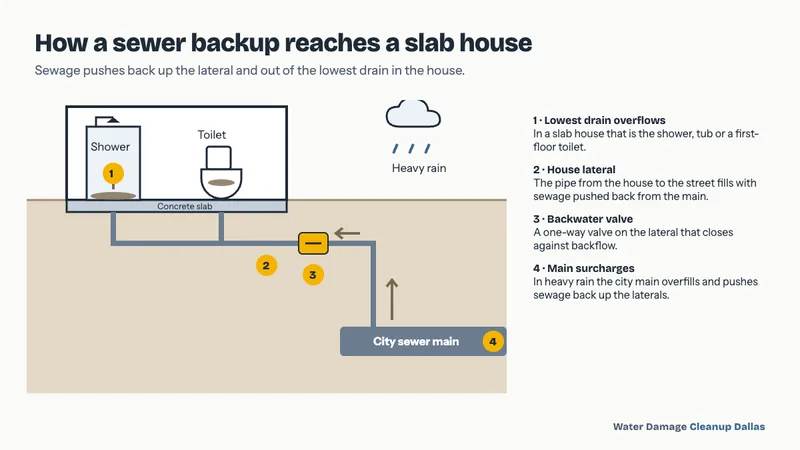
Common causes include roots in an older line, grease and wipes, a collapsed section and a main that fills during a heavy storm. Dallas rainfall can be intense: the National Weather Service normals for DFW Airport show 10.9 days a year with an inch or more of rain.
A plumber can usually run a camera through the line to see the cause. That finding matters, because it affects who pays and what repair is needed. A repair contractor comes later, once the source is fixed and the area dried.
Where does a sewage backup show up first, and what does it mean?
Look at the lowest fixtures first. A backup normally appears at a shower, tub or floor drain before it shows at a sink on a higher level. Where it appears, and how many fixtures are involved, helps a plumber narrow down where the line is blocked.
| What you notice | Likely meaning | Who checks it |
|---|---|---|
| One slow drain with a gurgle | Local clog in a branch line | Plumber |
| Toilet bubbles when the washer drains | Main house line is partly blocked | Plumber with a camera |
| Water in the shower or tub after flushing | Backup at the lowest drain in the house | Plumber, urgently |
| Several houses on the street affected | A problem on the sewer main | Plumber first, then ask Dallas 311 |
| A sewage smell with no visible water | A dry trap, a cracked pipe or a hidden leak | Plumber |
The table shows general patterns, not a diagnosis. For a smell with no visible source, water damage smell lists other causes to rule out.
Is sewage Category 3, and what happens to the materials it touches?
Yes. The IICRC S500 standard classes sewage as Category 3, grossly contaminated water, in the same group as rising flood water from rivers and streams. Porous materials that soak it up are generally removed, because they cannot be reliably cleaned.
| Material | Usual outcome |
|---|---|
| Carpet and pad | Removed and discarded |
| Drywall wet with sewage | Cut out past the wet line |
| Insulation | Removed if wet |
| Tile, concrete, sealed hard surfaces | Cleaned and disinfected in place |
| Upholstery and mattresses | Often discarded |
| Wood cabinets and trim | Judged case by case |
These outcomes are general patterns, and a provider or your adjuster makes the final call. Photograph items before they leave the house. The drywall page explains how cut lines are chosen.
What does sewage cleanup involve?
A provider removes the sewage, takes out materials that cannot be cleaned, cleans and disinfects what stays, dries the structure and records readings. The work usually starts with protective gear and containment so contamination does not spread to clean rooms.
- Containment: doors closed or sealed so the affected area stays separate.
- Removal: liquid pumped or vacuumed out, then solids and ruined materials bagged.
- Cleaning: surfaces washed and disinfected. For hard surfaces after a flood the CDC names household cleaner with soap, or bleach at up to a cup per gallon of water, and says never to combine bleach with ammonia.
- Drying: air movers and dehumidifiers until readings show dry framing and floors.
- Records: photos, disposal notes and drying logs for your claim.
Drying follows the same process as any other loss, covered at structural drying. The CDC adds that boots, gloves and goggles should be worn for cleanup and windows opened. If you cannot do all that, leave the cleanup to a provider.
Is sewage dangerous to my health?
Treat it as hazardous. Sewage is grossly contaminated water, which is why the EPA says to bring in a professional for sewage damage. People with a weakened immune system, asthma or chronic lung disease should be especially careful around contamination and mold that follows.
The CDC lists a stuffy nose, sore throat, coughing, burning eyes and skin rash as possible effects of mold, and says people with asthma or mold allergy can react severely. Those effects come from mold that grows after a wet loss, not only the sewage itself.
This page does not give medical advice. Ask a doctor if someone in the house has symptoms, and read the sewage exposure health page for what to watch for. Mold prevention depends on speed, and the EPA names 24 to 48 hours as the drying window.
Does insurance cover a sewage backup?
Often not, unless you added coverage for it. Triple-I reports that a typical homeowners policy leaves out sewer backups, and flood insurance does too. Cover is sold on its own or as an endorsement to the policy, usually for a modest premium.
Check your policy for a water backup or sewer backup endorsement. If you have one, phone your agent or insurer right away and film the damage. Keep every receipt, and hold on to damaged items until the adjuster has seen them.
Triple-I suggests collecting written bids from licensed contractors that list materials and prices line by line. When you disagree with a decision, begin with your agent or the claim department manager. The insurance claims page explains the Texas Department of Insurance steps, and TDI takes complaints through its consumer page.
Who is responsible if the backup came from the city sewer?
That depends on where the blockage sits, and this page cannot settle it. A plumber with a camera can show whether the stoppage is in the pipe serving your house or farther out in the street. That finding is the evidence everything else depends on.
People often ask whether the city or the homeowner is to blame. Dallas Water Utilities takes service requests through Dallas 311, online or by app, and after-hours water emergencies through a Request Emergency Services option. Ask them what applies, because the City pages used for this guide give no ownership rule to quote.
Keep a written log: the date, what you saw, who you spoke to and what they said. Save the plumber's report and any camera footage. If you think the city is at fault, ask your insurer and, if needed, an attorney, since this page cannot give legal advice.
How much does sewage cleanup cost in Dallas?
No verified Dallas price list exists for this page, so only national references appear. The national cost guide Fixr, updated January 31, 2025, lists water extraction for black water at $7 to $7.50 per square foot, the top of its three tiers.
Across the whole restoration job, Fixr shows $1,200 to $5,000 nationally, averaging $3,000. A sewage job can land toward the high end, because carpet, pad, drywall and insulation that touched Category 3 water commonly come out.
Factors that move a quote include the area and depth of the sewage, which materials are removed, whether contents need cleaning and how long drying takes. Providers set their own rates and a Dallas bid may differ from the national numbers. Compare written scopes using water damage restoration cost, and read the work authorization page before you sign.
How can I lower the chance of another backup?
Keep grease, wipes and other non-flushables out of drains, and have a plumber look at an older line before it fails. A camera inspection can show roots or a sagging section. For a house that has backed up before, ask whether a backwater valve makes sense.
- Watch the early signs such as gurgling drains and slow tubs.
- Know where your cleanout is so a plumber can reach the line quickly.
- Check for sewer backup coverage in your policy before a storm.
- Keep photos of your home's condition to support a claim.
A backwater valve is a plumbing fitting that lets sewage flow out of the house but not back in. Whether one is practical depends on the line, so get advice from a plumber. More prevention steps are on the prevent water damage page.
Sources: TDI, complaint page; Dallas Water Utilities, water main breaks and leaks; City of Dallas Water Utilities; NWS Fort Worth, DFW Records and Normals; Fixr, Water Damage Restoration Cost; Triple-I, Settling claims; Triple-I, Which disasters are covered; CDC, About Mold and Your Health; IICRC, S500 standard; EPA, A Brief Guide to Mold, Moisture and Your Home; EPA, Mold Cleanup in Your Home.