The short version
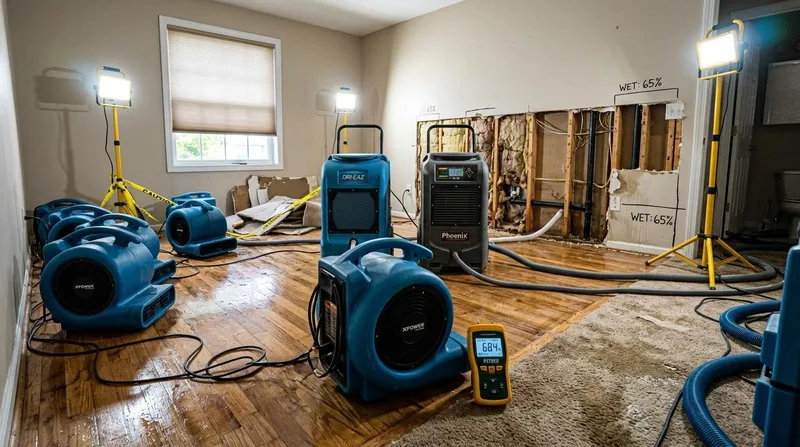
For appliance leak water damage in Dallas, close the shutoff valve, soak up standing water and photograph everything. Water from a washer or dishwasher is grey, Category 2 under the IICRC. The EPA advises drying wet areas in the first 24 to 48 hours. Wet carpet, cabinets or walls usually need a provider.
What should I do first when an appliance leaks?
Stop the water at the appliance, then at the house if you must. Close the small valve on the supply line, or unplug the unit only if the floor around the outlet is dry. Photograph the scene before you mop, since that record helps if you file a claim.
- Close the appliance's own shutoff valve behind or beside it. If it will not turn, use the main shutoff for the house.
- Keep your feet dry near power. Skip unplugging anything while you are standing in water, and cut the breaker instead if the panel is dry to reach.
- Pull the appliance forward only if you can do it safely, so the wall and floor behind it can be seen.
- Soak up standing water with towels and a wet-dry vacuum, and lift rugs and boxes off the floor.
- Take photos and a short video of the appliance label, the source of the leak and every wet surface.
- Start fans and open a window if the weather allows.
The burst pipe page shows where the shutoff valves sit in a slab house.
Which appliances leak most often, and where do they fail?
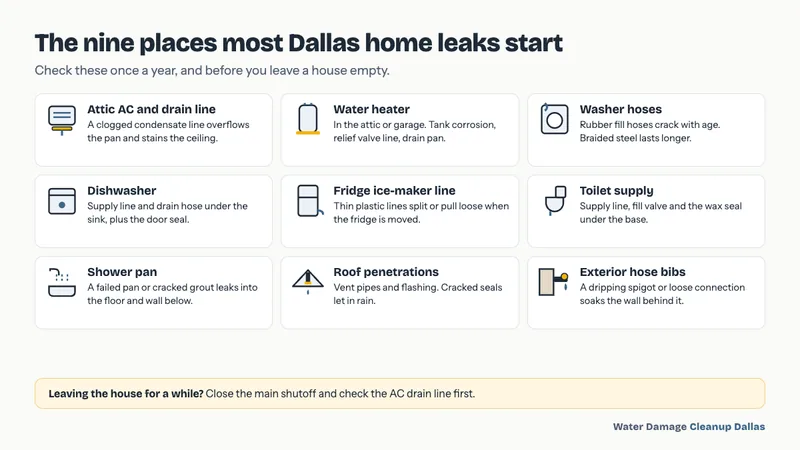
Washers, dishwashers, refrigerators with ice makers and water heaters are the usual suspects, and the failure point is almost always a hose, a fitting or a pan rather than the machine's body. Rubber and plastic parts age, and a small drip can run for weeks behind a unit.
| Appliance | Where it often leaks | Water type |
|---|---|---|
| Washing machine | Supply hoses, drain hose, tub seal | Supply is clean; machine discharge is grey |
| Dishwasher | Door gasket, inlet valve, drain hose | Grey |
| Refrigerator or ice maker | Small supply line, fitting at the wall | Clean |
| Water heater | Tank, relief valve, fittings, pan | Clean |
| Toilet | Supply line, tank seal, overflow | Clean to grey, unless waste is present |
The IICRC S500 standard calls water from a supply line Category 1, and water from a washer, dishwasher or toilet overflow without waste Category 2. Your provider decides how to classify your specific loss.
A water heater that leaks has its own page, water heater leaks in Dallas.
How does a washing machine leak cause water damage?
A burst or loose hose can pour water for as long as the machine is running, and an overflowing tub does the same in minutes. Where the laundry room has hard flooring, water spreads fast to the hallway, the adjoining closet and the wall base.
Because discharge water from a washer is grey, the IICRC puts it in Category 2. That affects what a provider will dry in place and what comes out, particularly carpet pad and the lower section of drywall.
A machine that vibrates its hose loose, a bulging hose or a rusted fitting are warning signs. If the washer sits on an upper floor of a condo or apartment, the water also reaches the unit below, and the apartment and condo guide explains who handles what.
What does a dishwasher leak do to the floor and cabinets?
It wets the toe-kick, the cabinet floor and the flooring under the dishwasher, often out of sight. A slow leak can run for weeks before a stain shows at the edge of the cabinet or a soft spot appears in the floor.
Look for water at the front seal, a warped floor edge, a musty smell in the kitchen or cabinets that feel damp inside. A stained cabinet base is a sign that the material below has been wet a while.
Particleboard cabinet bases swell and rarely return to shape, while solid wood and hard surface flooring dry more reliably. The bathroom and kitchen page covers cabinets, vanities and the flooring around them.
Can a fridge or ice maker line leak without anyone noticing?
Yes. The small supply line runs behind the refrigerator, where a drip can soak the wall base and the floor for a long time. Because the water is clean, the damage looks mild early on, but it can still reach drywall, cabinets and flooring.
Signs include a cold or wet patch behind the unit, a floor that cups or lifts near the fridge, a damp smell, or a water bill that climbs with no obvious reason. Pull the refrigerator out once a year and check the valve, the line and the floor.
If you suspect a leak you cannot see, the water meter leak test shows whether water is moving through the house while everything is off. Hidden leaks beneath the floor are on the slab leak page.
Is appliance leak water clean, grey or contaminated?
It depends on the source, and the source sets the category. The IICRC calls supply line water Category 1 and clean. Washer, dishwasher and waste-free toilet overflow water is Category 2, grey. Sewage and rising flood water are Category 3, grossly contaminated.
The category can worsen with time. Clean water that sits in carpet pad or wall cavities picks up bacteria and gets harder to treat. That is another reason the EPA stresses acting in the first 24 to 48 hours.
If the leak is a backup from a drain, treat it as contaminated and keep out of the area. The EPA advises calling a professional experienced with contaminated water, and the sewage backup page explains the next steps.
Can I dry up an appliance leak myself, or do I need a provider?
A small spill on a hard floor that you caught right away is a job for towels and a fan. A leak that soaked carpet, got under flooring or ran behind a cabinet is not, because water you cannot see keeps doing damage.
- Handle it yourself when the water was clean, the area is small, the floor is hard and everything dries in a day or two.
- Call a provider when carpet or pad is wet, when water reached drywall or cabinets, or when the leak ran for a long time.
- Call a provider when the water was grey or worse, or when a musty smell remains.
The wet carpet page explains what happens to carpet and pad after an appliance spill.
What happens to floors and walls after an appliance leak?
Flooring reacts by material. Laminate and engineered wood swell at the seams, hardwood cups, vinyl can trap water underneath, and carpet holds water in the pad. Drywall wicks the water up from the base and can soften at the bottom edge.
Fixr's cost guide lists extraction at $4.10 to $6.50 per square foot for gray water and restoration at $4.75 to $10.50 per square foot for carpeting and $10 to $15 for hardwood. These are national averages for a restoration job, not Dallas quotes.
The water damaged floor page walks through each flooring type, and the water removal page explains how standing water is pulled out before drying.
Will my Texas homeowners policy pay for an appliance leak?
Often, for a sudden leak. The Triple-I says standard forms name accidental discharge or overflow of water from a household appliance, plumbing or air conditioning as covered perils. Your own policy wording decides, so ask your agent before you assume anything about a specific claim.
- Policies will not cover damage from lack of maintenance, per the Triple-I. A hose that was known to be failing may draw questions.
- Mold cleanup is often excluded, according to the NAIC.
- About one in 60 insured homes files a water damage or freezing claim each year, and the Triple-I puts the average at $15,400 for 2019 to 2023.
- TDI says the insurer has 15 business days to acknowledge a claim, and must pay within five business days once it agrees to.
Call your insurer early and keep receipts, as the Triple-I advises. The insurance claims guide covers the process.
How can I stop appliance leaks before they start?
Check hoses and fittings on a schedule and replace the ones that look worn. Most appliance floods start at a part that was already showing wear, so a short walk-through a couple of times a year catches many of them before they fail.
- Inspect washer hoses for bulges, cracks and rust at the couplings, and replace them if they are worn.
- Pull out the fridge and look at the ice maker line and valve.
- Check under the dishwasher and sink cabinets for damp spots or stains.
- Learn where your shutoffs are, and test that they turn.
- Do not run machines when nobody is home, where practical.
The prevention guide adds a whole-house checklist.
When should I call a restoration provider for an appliance leak?
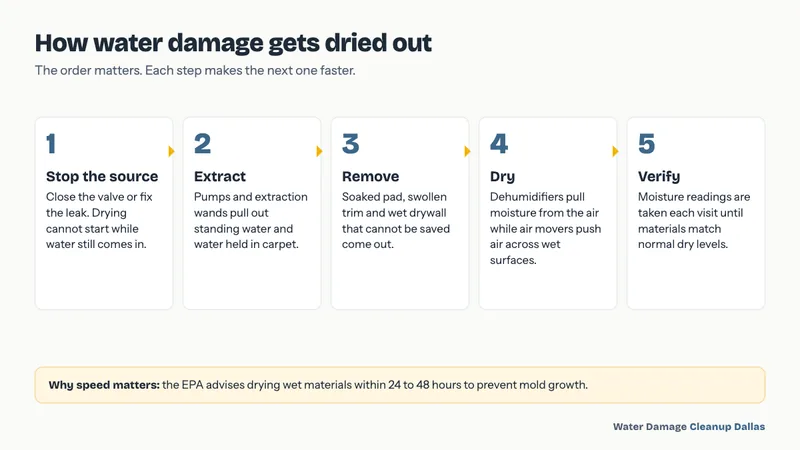
Call when water got into carpet, flooring, drywall or cabinets, when the leak ran unseen for a while, or when the water was grey or contaminated. A provider extracts what remains, dries the structure and takes moisture readings so you know it is dry.
- Stop the water and photograph everything.
- Name the source to the provider and how long the leak ran.
- Ask for readings before and after drying.
- Confirm who rebuilds any cut-out walls or floors.
- Read the paperwork before you sign, using the guide to choosing a restoration company.
This site connects callers with independent providers and does not do the work itself. Providers differ in services and availability, so confirm directly.
Sources: IICRC S500 water categories; EPA mold and moisture brief guide; EPA mold cleanup page; Triple-I covered disasters; Triple-I claims after a disaster; Triple-I homeowners statistics; NAIC homeowners consumer page; TDI claim payment steps; Fixr cost guide