The short version
A water meter leak test takes two readings with every tap and appliance off. The EPA says that if the meter changes at all in two hours, you probably have a leak. Rule out toilets and irrigation, close the house shutoff to narrow it down, and call a plumber if the dial keeps moving.
What is a water meter leak test?
A water meter leak test checks whether water is moving through your meter while nothing in the house should be using any. If the reading changes during a quiet stretch, water is escaping somewhere on the property. It costs nothing, needs no tools and works on any house.
This site is a referral service, not a plumbing or restoration contractor, so it does not run the test for you. This guide explains how to do it, what the results can and cannot tell you, and who to call next. It also covers the Dallas details we could verify.
The test matters most for hidden pipes. In a house on a concrete slab, which describes most of North Texas, some supply lines run under the floor where nobody sees them. The slab leak water damage guide covers what follows if the test says water is escaping.
How do I do the water meter leak test step by step?
Stop all water use, read the meter, wait two hours with nothing running, and read it again. The EPA's WaterSense program says that if the numbers have changed at all after those two quiet hours, a leak is probable. Use a phone photo for each reading.
- Close every tap and stop every appliance that uses water, including the dishwasher, washer, ice maker and any irrigation timer.
- Make sure nobody flushes a toilet or runs a shower during the test.
- Open the meter box lid carefully, watching for insects and debris, and note the full reading on the register.
- Photograph the meter with the time visible on your phone, so you have a record.
- Wait two hours and leave the house's water alone.
- Read the meter again and compare it with the first photo.
If the reading is unchanged, the plumbing is probably not leaking at that moment. A slow leak that only runs under certain pressure, or one that comes and goes, can slip through a single test, so repeat it on another day if the clues remain.
How do I read the dial or the leak indicator on my meter?
Meters differ, so look at yours before the test. Many show a row of digits for total use and a small marker that spins when even a tiny flow passes through. Compare the digits before and after, and watch the small marker, which can reveal a slow leak sooner than the digits do.
If your meter has a low-flow indicator, check it with all water off. A marker that keeps turning while every fixture is closed is a quick warning on its own, without waiting two hours. If you cannot tell which marker is which, take a photo and ask Dallas Water Utilities.
The City of Dallas lists Water Customer Service at (214) 651-1441, Monday to Friday, 8 a.m. to 5 p.m., and says service requests go through Dallas 311 online or the 311 app. Ask there if the meter box is flooded, cracked or hard to read, and do not pry at the meter itself.
What do the results of the test mean?
A meter that does not move is good news for the plumbing. A meter that moves means water is going somewhere, and the next step is narrowing down where. The table below turns each outcome into a likely meaning and a safe next move.
| What you see | Likely meaning | Safe next step | Who to call |
|---|---|---|---|
| Reading unchanged after two hours | No steady leak at the time of the test | Repeat later if you still hear water or see damp spots | No one yet |
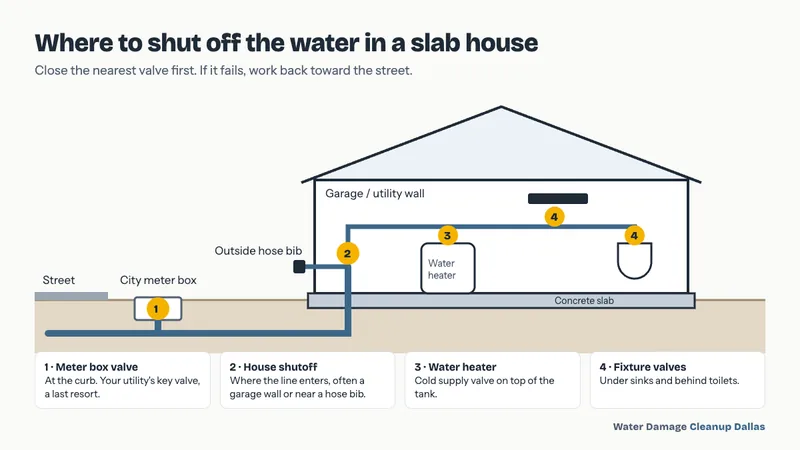
| Reading moved, and it stops when the house shutoff is closed | Leak inside the house or on the house side of the shutoff | Check toilets, hose bibs, the water heater and the AC drain | Plumber |
| Reading still moves with the house shutoff closed | Leak between the meter and the house valve, or a faulty valve | Look for wet ground or a soft patch along the line | Plumber, and Dallas 311 if it is at the meter box |
| Small marker spinning, digits barely changed | A slow leak, often a toilet or a dripping fixture | Run the toilet dye check below | Plumber if the toilets are clean |
| Warm floor spot or damp flooring plus a moving meter | A possible slab leak | Shut the main valve and photograph the damage | Plumber first, then a restoration provider |
A test result is a clue, not a diagnosis. A plumber confirms the source with proper tools, and a restoration provider handles any wet floors or walls once the leak is stopped.
Does a moving meter always mean a slab leak?
No. Toilets, irrigation lines, hose bibs and dripping fixtures all move the meter, and they are far more common than a break under the slab. Rule them out first, because they are the easiest fixes and usually the cheapest ones to make.
Per the EPA, leaks in a typical home lose upwards of 9,300 gallons a year, and nine percent of homes lose at least 50 gallons daily. Its list of usual suspects is worn toilet flappers, dripping faucets and leaky valves.
- Toilets: the EPA says to put a few drops of food coloring in the tank. If color shows up in the bowl after 10 minutes, the toilet is leaking. Flush right afterward so the dye does not stain.
- Irrigation: the EPA says a leak 1/32 of an inch wide, about the thickness of a dime, can waste around 6,300 gallons of water a month. Close the irrigation supply, if there is a separate valve, and test again.
- Outdoor taps and hoses: check for drips at the spigot and at any hose left attached.
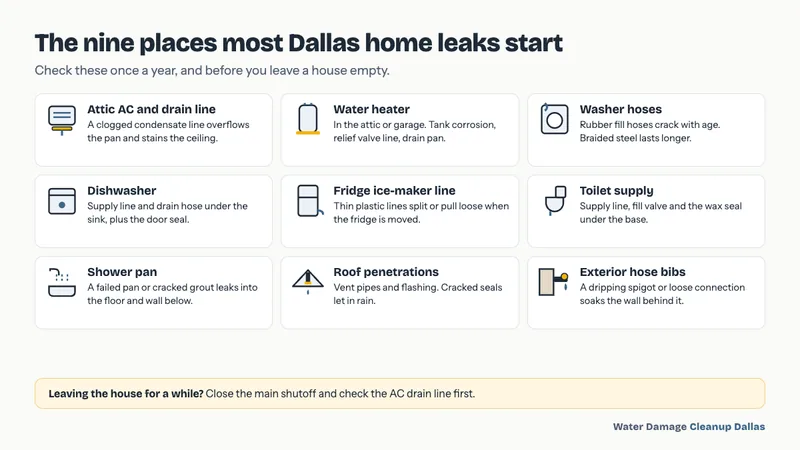
- Appliances: look behind the washer, dishwasher and refrigerator for wet floors or damp hoses.
The appliance leak page and the water heater leak page cover the other sources that can move a meter.
Can I find a leak just by reading my monthly bill?
A bill can hint at a leak but cannot locate one. The EPA says to look at usage in a colder month such as January or February, and that a family of four using more than 12,000 gallons a month then could have serious leaks. Winter is useful because lawns need little water.
Compare each bill with the same month a year earlier, and with the month before. A jump that does not match a change in your household, a house guest or a new pool is worth testing. A single high bill can also come from a misread meter or an estimated reading, so confirm with the meter itself.
NWS normals for DFW Airport put the normal January low at 36.1 F, and a hard freeze can split a pipe and send the bill up on its own. Read the signs of water damage guide to match a bill with what you see around the house.
Whose leak is it, mine or the city's?
The Dallas pages we checked do not say which section of pipe belongs to the customer and which to the city, so we give no rule here. Ask Dallas Water Utilities before you pay for work in the yard or at the meter box, and ask for the answer in writing.
What the city does say is how to report a leak on its system. Dallas Water Utilities says leaks can be reported by calling 3-1-1, through Dallas 311 online or in the Dallas 311 mobile app. After-hours water emergencies use the Request Emergency Services option on the Water Utilities page.
The same City News Hub post says Dallas Water Utilities manages just over 5,000 miles of water mains and that dry expansive soil and high demand are among the contributors to breaks. Wet pavement or a flowing gutter on a dry day in front of your house is a good reason to call.
What should I do if the meter keeps moving?
Close the main shutoff, confirm the meter stops, and call a plumber. Do not run the water to look for the leak, and do not wait for a larger stain. Then note what you saw, because the details help the plumber and any insurer.
- Close the house shutoff and watch whether the meter stops.
- Write down the readings and times, and keep the photos.
- Walk the house and note warm floors, damp baseboards, musty smells and wet drywall.
- Call a plumber who finds hidden leaks and tell them what the meter did.
- If floors or walls are wet, arrange drying through a restoration provider.
For visible failures the burst pipe page is the better starting point, and the emergency water damage restoration page explains the first stage of a job.
How does a meter test help with an insurance claim?
The test gives you dated readings that show water was escaping and roughly when you noticed it. An insurer will ask whether a leak was sudden or ongoing, and your photos and notes answer part of that. They do not settle the question, but they make your account easier to check.
Insurance trade group Triple-I says to call your insurer at once, record the damage on camera and avoid big permanent repairs before an adjuster inspects. Keep every receipt too.
On coverage, Triple-I lists accidental discharge or overflow from plumbing among standard perils, with neglect and poor upkeep excluded. A leak you ignored after the meter flagged it could be treated differently from one you acted on. The water damage insurance claims guide covers the process.
When should I stop testing and call someone?
Call when the meter still moves after you close the house shutoff, when floors or walls are wet, or when the water may be sewage or flood water. Those cases need a plumber, a provider or both, and contaminated water is a safety matter first.
Mold is the clock here: the EPA wants wet areas and belongings dry in the first 24 to 48 hours, so waiting weeks is a poor plan. If the water was sewage or otherwise contaminated, the EPA's cleanup page says to bring in a professional experienced with such buildings.
Each provider sets its own scope, so ask the one you reach what is included. The choosing a restoration company guide lists questions to ask, and the structural drying page explains how wet materials are dried and checked.
How do I keep checking for leaks after the test?
Make the test a habit. Read the meter before and after any trip, scan the bill each month and look at the usual leak points whenever you are in the attic or garage. Catching a drip early costs far less than finding it after floors have soaked.
- Run the two-hour test once or twice a year, and any time a bill looks odd.
- Keep a photo of the meter register from the day you finished a repair, as a baseline.
- Check toilets with food coloring once a season.
- Know where the house shutoff is and make sure it turns.
- Add battery leak sensors under sinks and beside the water heater and washer.
The water damage prevention guide has a fuller checklist. The EPA says fixing easily corrected household leaks can save about 10 percent on water bills, so the test often pays for itself.
Sources: EPA WaterSense leak guidance; City of Dallas Water Utilities; Dallas City News Hub on main breaks and leaks; NWS DFW normals; EPA mold and moisture brief guide; EPA mold cleanup page; Triple-I on settling claims; Triple-I on homeowners coverage.