The short version
Flood cleanup in Dallas deals with outside water, which IICRC treats as Category 3. Stay out of the water, call your insurer, photograph the damage and expect porous materials to come out. Triple-I notes that standard homeowners policies leave out flood damage. Check whether you hold a separate flood policy.
What is flood cleanup in Dallas, TX?
Flood cleanup is the work of removing outside water, mud and ruined materials from a building, then drying and sanitizing what remains. It differs from a plumbing leak because the water came from outdoors and carries whatever it crossed. Flood restoration then rebuilds what had to come out.
People search this under several names: flood damage restoration, flood restoration, flooded house cleanup. They describe the same chain of work. This site refers Dallas-area property owners to independent restoration providers and does none of the work itself, so scope and terms come from the provider you reach.
For a pipe or appliance leak, start at water removal in Dallas instead. The pages below deal with water that came in from the yard, the street or a creek.
Why does Dallas flood after heavy rain?
Intense storms drop more rain than the ground and drains can take. Dallas sits on mostly flat land with the Trinity River running through it, and the Wikipedia article on Dallas notes the river is flanked by earthen levees built to guard the city from frequent floods. Creeks and low streets fill first.
Numbers from official sources show the range. The National Weather Service normals for DFW Airport list 37.01 inches of rain in a normal year, with May the wettest month at 4.78 inches. Storms can concentrate that: the NWS says the May 5, 1995 Mayfest storm brought rainfall rates near 2.25 inches in 15 minutes over Dallas County, and 15 people died in Dallas County, several after driving into high water.
The City of Dallas flood control brochure from March 2020 says the levee system protects 10,000 acres of residential and developed commercial and industrial property. It also lists 41 flooded roadway sites. A levee does not stop water from collecting in a street or a yard far from the river, so a house can flood without being near it.

What should I do first when flood water enters my house?
Get everyone out of the water, stay away from electrical hazards and do not drive through flooded streets. Per Ready.gov, a person can be knocked down by six inches of moving water, and a vehicle swept off by one foot. Cleanup begins only once the water stops rising and the area is safe.
- Stay out until it is safe. Do not wade through water that may touch outlets, appliances or the panel.
- Call your insurer at once. Triple-I tells policyholders not to wait.
- Photograph and film everything before touching it, and keep damaged items for the adjuster.
- Protect what you can. Take reasonable steps to prevent more damage, and keep receipts.
- Wear boots, gloves and goggles for any cleanup, as the CDC advises.
- Reach a restoration provider and confirm scope and terms directly.
Pumping, tear-out and drying are different tasks, and a provider may offer only some of them. If the water came with sewage, go to sewage backup cleanup and read the sewage exposure health page before you touch anything.
What counts as flood damage, and why is the water Category 3?
Flood damage is harm caused by water that rose or ran in from outside. Under IICRC S500, water that rises out of rivers and streams, plus surface water from outdoors, falls in Category 3, the grossly contaminated class that also holds sewage. That label drives how the cleanup is done.
| Water source | Category | Usually covered by |
|---|---|---|
| Creek or river overflow | 3 | A flood policy, not standard homeowners |
| Street or yard runoff entering a door | 3 | A flood policy, not standard homeowners |
| Sewer backup | 3 | A sewer endorsement, if you bought one |
| Burst supply pipe | 1 | Often homeowners, per the policy |
| Roof leak after a storm | Varies | Often homeowners, per the policy |
Rain that hits the roof and drips through a damaged section is a different claim from water that enters at ground level. The first is a roof leak, handled at roof leak and storm water damage. Confirm the category with a provider and your insurer, since they may classify borderline cases differently.
What does flood damage restoration involve?
A provider removes water and mud, takes out materials that cannot be cleaned, dries the structure, cleans and disinfects surfaces, and records readings before any rebuild begins. Category 3 water means porous materials such as carpet, pad and insulation usually go to the curb instead of being dried.
- Extraction: pumps and vacuums clear standing water, then mud is shoveled or hosed out.
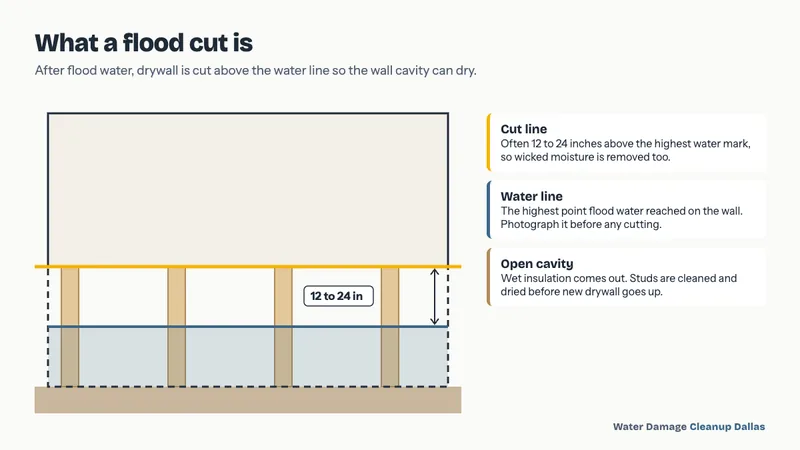
- Tear-out: soaked carpet, pad, cabinets and drywall that touched flood water are cut out. A cut line is often made above the water mark.
- Drying: air movers and dehumidifiers run until readings show the framing and slab are dry.
- Cleaning: hard surfaces get washed down, and the CDC gives a mix of household cleaner and soap, or up to a cup of bleach per gallon of water.
- Documentation: photos, drying logs and invoices are kept for the claim.
Never mix bleach with ammonia or other cleaners, the CDC warns, and open windows while you work. Each step has its own page: structural drying and water mitigation describe the drying side.
What gets thrown out after a flood, and what can be saved?
Porous items that soaked in flood water are usually thrown out, and hard, non-porous items can often be cleaned. The CDC says soaked carpets and upholstery that cannot be dried promptly should go. Keep damaged items until the adjuster has seen them, then discard.
| Item | Typical outcome | Why |
|---|---|---|
| Carpet and pad | Usually removed | Absorb contaminated water |
| Drywall touched by flood water | Often cut out | Wicks water upward |
| Insulation | Removed if wet | Holds moisture against framing |
| Tile and concrete | Often cleaned in place | Non-porous surface |
| Upholstered furniture | Often discarded | Cannot be dried right away |
| Solid wood furniture | Sometimes cleaned and dried | Depends on how long it stayed wet |
Treat the outcomes as general patterns, since a provider decides case by case. For valuables and furniture you want to keep, contents cleaning and pack-out explains how items are moved and cleaned off site.
Does homeowners insurance cover flood damage in Dallas?
Usually not. Triple-I reports that standard homeowners and renters policies exclude flood damage, so you need a separate flood policy, sold through the NFIP or a small number of private insurers. FEMA agrees that most homeowners insurance leaves flooding out of coverage.
NAIC draws the line from the other direction. Ground water, rain runoff and snow-melt are excluded, and a plumbing or roof leak typically is not. Sewer backup sits outside both a standard homeowners policy and flood insurance, so it takes its own endorsement or product.
Check which policy you hold before you file. A homeowner with only a standard policy has to look to other help, and the insurance claims page walks through the Texas side. For an address you are thinking of buying, flood zones in Dallas explains how the maps are used.
How do I report flood damage?
Tell your insurer first, then keep a written record. If you carry a flood policy, report under it, since it is separate from your homeowners policy. Photos, video and receipts support whichever claim applies, so start collecting them before any cleanup begins.
The Texas Department of Insurance lays out the timeline. A company gets 15 business days to acknowledge a claim, then 15 business days after it has what it needs to decide.
Per TDI, a company can add 45 days if it explains why, and TDI can add 15 more after a weather-related catastrophe. A rejection must come with written reasons. Once the company agrees to pay, payment is due in five business days.
If you disagree, Triple-I says to start with your agent or the claim department manager. TDI takes complaints at its consumer page, and its general questions line is 800-252-3439.
Has this Dallas property flooded before?
Texas law gives buyers and renters a few ways to ask. Under Property Code 5.008, as amended by SB 339, the seller's disclosure notice asks about previous flooding, flood insurance and whether the property is in a 100-year or 500-year floodplain, for contracts signed on or after September 1, 2019.
Renters have a similar notice. The enrolled text of HB 531 says a landlord must state whether the dwelling is in a 100-year floodplain and whether it flooded at least once in the last five years, for leases entered into or renewed on or after January 1, 2022. It also points tenants to FEMA's free, address-searchable flood map and notes that most tenant policies do not cover flood damage.
Read those forms closely and ask questions. See buying a flooded house and apartment and condo water damage for the next steps.
How do I keep mold from growing after a flood?
Dry everything fast. After a flood the CDC wants the home cleaned and fully dried quickly, inside 24 to 48 hours, and the EPA names the same window for wet areas and items. Mold can grow quickly on damp material, especially in warm weather.
The EPA sets a humidity goal under 60 percent, ideally 30 to 50 percent, and warns against painting or caulking over mold. Per the CDC, mold can bring a stuffy nose, coughing, burning eyes or a rash, with stronger reactions for people with asthma, allergies, weak immunity or lung disease.
The EPA considers a patch under roughly 10 square feet a usual do-it-yourself job, while a larger one, or contaminated water, calls for a professional. Texas licenses mold assessors and remediators through TDLR, which lists exemptions for small projects. The mold after water damage guide covers the details.
How much does flood cleanup cost in Dallas?
There is no verified Dallas price list for this page, so only national ranges are given. Fixr's national figures, updated January 31, 2025, put water extraction at $7 to $7.50 per square foot for black water, and restoration at $1.50 to $3 per square foot for drywall and $4.75 to $10.50 for carpeting.
Its mold line runs $4.75 to $5.50 per square foot. Flood jobs tend to cost more than clean-water leaks because the materials that touched Category 3 water often have to be replaced, not dried.
Prices are the provider's to set, and a Dallas quote can sit above or below national ranges. Ask for a written scope that separates extraction, tear-out, drying, cleaning and rebuild. The water damage restoration cost page compares more figures.
Sources: Fixr, Water Damage Restoration Cost; Texas HB 531 (87th); Texas SB 339 (86th); Wikipedia, Dallas; City of Dallas Water Utilities, Flood Control brochure, March 2020; NWS, The Mayfest Storm; NWS, DFW Records and Normals; TDLR, Mold Assessors and Remediators; EPA, Mold Cleanup; EPA, Mold and Moisture; CDC, About Mold and Your Health; Ready.gov, Floods; IICRC, S500; TDI, complaint page; TDI, Getting your claim paid; NAIC, Homeowners Insurance; Triple-I, Settling claims; Triple-I, Which disasters are covered; FEMA, Don't have flood insurance.