The short version
Sewage exposure health risks start with contact. The EPA says to avoid or limit contact with contaminated water, wash hands often, keep children away and report cuts and symptoms. Call a professional experienced with contaminated water, and ask your insurer about backup cover separately.
What are the sewage exposure health risks after a backup?
The EPA says flood water may carry high levels of raw sewage and other hazardous substances, and it urges people to avoid or limit direct contact with it. Early symptoms can include an upset stomach, intestinal problems, headache and flu-like discomfort. Treat sewage that backs up inside a house with the same caution.
The EPA's flooding page is plain about it: limit contact, wash your hands often, and keep children away. This page repeats what the EPA and CDC say and gives no medical advice of its own. For your own health questions, talk to a doctor.
The cleaning industry's IICRC S500 standard puts sewage in Category 3, grossly contaminated water. That category also covers rising flood water from rivers and streams and outside surface water. Materials touched by Category 3 water are handled differently from a clean supply line leak.
Who should stay out of the house during sewage cleanup?
Children, people with asthma or mold allergy, people with weakened immune systems or chronic lung disease, and anyone with an open cut should stay out of a sewage-affected area. The EPA says children should not play in flood water, and the CDC names those conditions as higher risk from the mold that follows wet damage.
| Who | Why it matters | What the source says | Practical step |
|---|---|---|---|
| Children | Crawling and mouthing objects raise exposure | EPA: protect children, and do not let them play in flood water or with toys it touched | Keep them in a dry, unaffected part of the home or elsewhere |
| People with asthma or mold allergy | Mold often follows contaminated water | CDC: reactions to mold can be severe | Stay out and ask a doctor about your own situation |
| Weakened immune systems or chronic lung disease | Higher risk from mold exposure | CDC: may develop lung infections | Stay away from the work area |
| Anyone with cuts or open wounds | Wounds can contact contaminated water | EPA: report cuts and open wounds, and keep vaccinations current | Avoid contact and tell a doctor |
| Pets | They walk through and lick surfaces | No agency guidance cited here | As a general precaution, keep them out of wet rooms |
If a whole room is unusable, the loss of use coverage topic explains the part of a policy that may help with temporary housing.
Where does sewage come into a Dallas home?
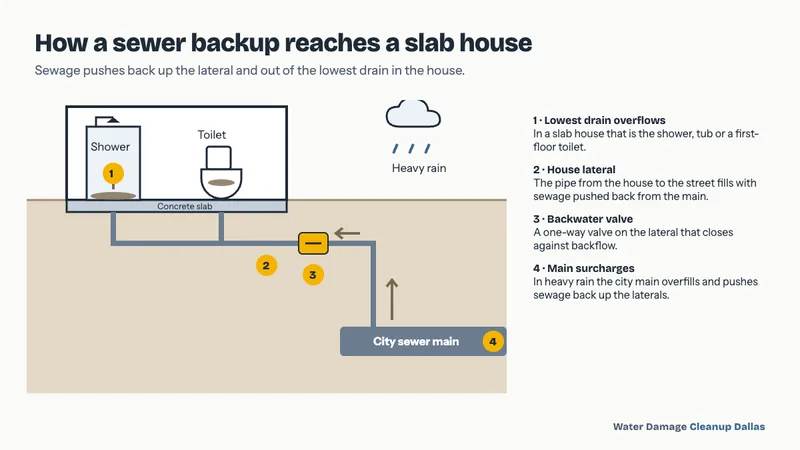
Sewage enters through the lowest opening in the drain system. In a slab house, that is usually a tub or shower drain, a floor drain or a ground-floor toilet. The water follows the path of least resistance, so the first sign is often a gurgle or a slow drain.
A blockage in your own line backs up the same way as a problem in the line beyond your property. Because you cannot tell which from inside the house, a plumber's diagnosis comes first. Stop running water, since every gallon you add has to go somewhere.
In a house with no lower level, sewage stays on the main floor, where it reaches flooring, baseboards and cabinet bases. The sewage backup cleanup page lists the materials a provider usually checks.
What symptoms can follow contact with sewage water?
The EPA lists upset stomach, intestinal problems, headache and flu-like discomfort as early symptoms of exposure to contaminated flood water. It says anyone with those symptoms, or any other problems, should seek medical attention immediately. Do not wait to see whether they pass if you were in the water.
The EPA also asks people in contact with flood water to wash their hands frequently with soap, especially before drinking and eating. Report cuts or open wounds, report all symptoms of illness, and keep vaccinations current.
Mold adds a second set of symptoms if the structure stays wet. The CDC names congestion, sore throat, coughing, wheezing, irritated eyes and rashes as the usual mold effects. The mold after water damage guide covers the drying window and Texas licensing.
What should I do right after a sewage backup?
Get people out of the affected rooms, stop adding water to the drains, and wash your hands. Then document the damage and call the people who can fix the cause and clean what it touched. Each step below protects health first and the claim second.
- Clear the rooms. Children and anyone in the higher-risk group above go first, and pets with them.
- Stop using the plumbing in the affected area until a plumber says it is clear, so you do not push more water out.
- Wash your hands with soap, especially before eating or drinking.
- Photograph and film the damage before cleanup. Triple-I advises keeping damaged items on hand until the adjuster has seen them.
- Call a plumber to find the cause. If it may be outside your property, Dallas Water Utilities takes service requests through Dallas 311 online or the 311 app.
- Call your insurer and ask how a sewer backup is covered.
- Ask for a provider through the contact page, and say the water was sewage.
The sewage backup cleanup page describes the work that follows.
Can I clean up sewage water myself?
When the cause is sewage or other contaminated water, the EPA's advice is to bring in a professional who has worked on buildings hit by that kind of water. That is the agency's answer for sewage, and it is why this site points you to providers instead of DIY steps.
Until help arrives, keep to low-risk actions. The CDC advises rubber boots, gloves and goggles for mold cleanup and open windows for ventilation. The EPA also warns against running a heating and cooling system you suspect is moldy, since the air handling can carry mold through the building.
Porous belongings are a separate question. The contents cleaning and pack-out page explains what providers may do with them, and providers differ, so confirm directly what each handles.
What should I tell a doctor or provider about the exposure?
Write down what happened while it is fresh: when the backup started, which rooms were affected, who touched the water and which symptoms followed. A short log helps a doctor ask the right questions and gives a provider and an adjuster the same timeline.
Include small details, such as who walked through the water in bare feet or whether anyone had a cut. Add photographs of the affected rooms, taken before cleanup begins.
Keep the log with your claim papers. The work authorization guide explains what to read before you sign for any cleanup, and the guide to choosing a restoration company lists questions to ask about contaminated water.
When does flood water count as sewage-level contamination?
Under the IICRC S500, rising flood water from rivers and streams and outside surface water are Category 3, the same grossly contaminated class as sewage. Flood water that gets into a Dallas home through a doorway or low slab edge should be treated that way until a professional says otherwise.
Dallas does see heavy rain. The NWS normals for DFW list 10.9 days a year, on average, with 1.00 inch of rain or more. Check the flood zone map topic to see how your address fits, and read the flood cleanup page for what follows.
Do not wade in it. Per Ready.gov, moving water only six inches deep can topple a person, and a foot of it can carry a vehicle off.
What about a septic system or a well after a flood?
If your home has a septic system, the EPA says not to use it until the water in the soil absorption field is lower than the water level around the house. If you use a household well, do not turn on the pump because of electric shock danger.
The EPA adds that you should not drink or wash with water from a flooded well until it has been tested and is safe to use. For city water, check with your local drinking water utility or health department about any boil water advisory. The EPA says to bring water to a rolling boil for 1 full minute.
Does insurance cover sewage backup damage?
Usually not under a basic policy, so check your declarations page before you assume either way. According to Triple-I, a typical homeowners policy leaves out sewer backups, and flood insurance does too. Cover is sold separately, as its own product or an endorsement, usually at a nominal cost.
Outside flood water is a different line. Flood damage is excluded from standard homeowners and renters policies, Triple-I notes, and FEMA likewise says most homeowners coverage does not respond to flooding. Read the insurance claims guide for the order of calls to make.
Triple-I also advises contacting your agent or company immediately and saving receipts. The CLUE report topic explains how claims show up later.
Sources: EPA, Flooding; EPA mold cleanup guide; CDC mold and health page; IICRC, S500 standard; Ready.gov, Floods; NWS Fort Worth/Dallas, DFW Records and Normals; Triple-I disaster coverage explainer; Triple-I claims settlement article; FEMA, Don't have flood insurance; City of Dallas, Water Utilities