The short version
Water damage restoration cost in Dallas has no verified local price list. National guides put a typical job at about $1,200 to $5,700, and the water type, wet area, materials and drying time decide where yours lands. Get itemized written estimates and ask what each one includes.
How much does water damage restoration cost in Dallas?
No verified Dallas price list exists, so this page uses national guides and says so each time. Two of them put a typical job between about $1,200 and $5,700, with averages near $3,000 to $3,500. A provider's own inspection of your house is what produces a real number.
Fixr's cost guide, updated January 31, 2025, gives a range of $1,200 to $5,000 and a national average of $3,000. Bob Vila's guide, updated May 30, 2023 and drawing on Angi and HomeAdvisor, gives $1,305 to $5,707 with an average of $3,455.
Treat those as a sanity check. A burst attic pipe that soaks three rooms and a hail leak that stains one ceiling are different jobs, and the bill follows the job. The people who answer this site's phone line are not a contractor and cannot quote your house. The sections below explain what moves the number, so an estimate makes sense when it arrives.
What do water extraction rates look like per square foot?
Extraction is usually priced per square foot, and the rate climbs with how dirty the water is. Fixr's guide shows three bands. Clean water runs $3.75 to $4.25, gray water $4.10 to $6.50, and black water $7 to $7.50. They are national averages, good for comparing quotes and poor for predicting one.
| Water type | Typical Dallas source | Extraction per sq ft (Fixr) |
|---|---|---|
| Clean (Category 1) | Burst supply line, frozen pipe, water heater leak | $3.75 to $4.25 |
| Gray (Category 2) | Washer or dishwasher overflow | $4.10 to $6.50 |
| Black (Category 3) | Sewage, creek or river flood water, outside surface water | $7 to $7.50 |
The labels come from the IICRC S500 standard. Category 1 means clean water from a supply line, Category 2 means gray water from a washer or dishwasher, and Category 3 covers sewage and flood water from rivers, streams or outdoor surfaces. Ask the provider which category it assigned to yours, and why.
What do restoration costs look like by material?
Once the water is out, the wet materials decide the next layer of cost. In Fixr's guide, restoring drywall runs $1.50 to $3 per square foot, carpeting $4.75 to $10.50, plaster $6.25 to $18.75 and hardwood $10 to $15. Mold work adds $4.75 to $5.50 per square foot.
Fixr also lists flat ranges by damage class. Class 1 runs $150 to $400, Class 2 runs $500 to $1,000 and Class 3 runs $1,000 to $3,000. Class refers to how much of a space is wet and how fast the materials will give up water, so a single damp wall is a different class from a soaked room.
These numbers show why carpet and hardwood swing a bill so much. A carpeted living room that can be dried in place costs far less than a hardwood floor that has to come up. See water damaged floor repair and wet carpet drying for how that decision gets made.
What changes the cost of water damage restoration in Dallas?
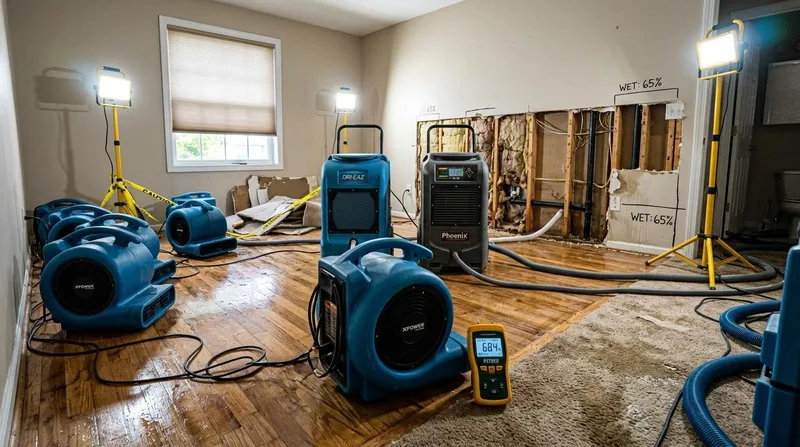
Six things move the price most: how much area is wet, the water category, how long it sat, which materials absorbed it, how much has to be torn out, and how long drying takes. Where the water came from often decides several of these at once.
- Area. Extraction and drying are measured in square feet, so a wet hallway and a wet house are not close.
- Water category. Sewage or flood water costs more per square foot than a clean supply line.
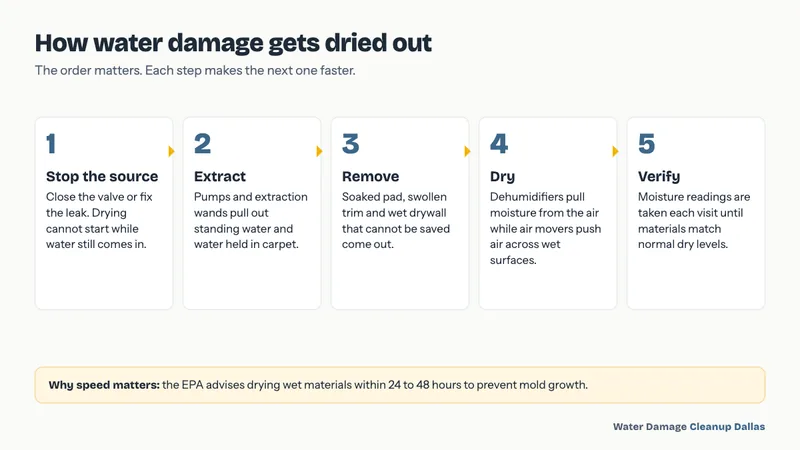
- Time. Per the EPA, wet areas and belongings should be dry inside 24 to 48 hours if you want to avoid mold. Waiting can add a mold line.
- Materials. Drywall, carpet pad, insulation and hardwood each behave differently when wet.
- Access. An attic leak that ran down through insulation and a ceiling touches more layers than a leak under a sink.
- Drying length. Equipment is usually billed per unit per day, so humid conditions that slow drying raise the total.
North Texas weather feeds these jobs from several directions. The National Weather Service reports that hail on April 11, 2016 affected 80 percent of homes in Wylie and caused more than $300 million in damage. Roof and ceiling repair then becomes part of the bill, which is covered on roof leak and storm water damage.
What is the difference between mitigation cost and repair cost?
Mitigation is the emergency work that stops the damage from growing: extraction, removing wet materials and drying. Repair rebuilds what was removed, such as drywall, paint, flooring and trim. They are usually quoted and billed separately, so a mitigation invoice does not include the rebuild.
This matters when you compare quotes. One provider may price only the drying, while another prices drying plus rebuilding, and the second number will look higher for good reason. Ask each one in writing what the quote includes and what it leaves out.
Read water mitigation for the emergency stage and water damage repair for the rebuild. Drying itself is explained on structural drying, which also shows why equipment days appear as their own line.
How much do ceiling, drywall and floor repairs cost after water damage?
Bob Vila's national guide gives ceiling repair at $350 to $1,250, drywall repair at $1.50 to $3 per square foot, and floor restoration at $200 to $500. Its mold removal range is $1,100 to $3,400, with an average of $2,200. These are repair costs, not drying costs.
In the same guide, a space with about an inch of clean water is priced at $500 to $1,500. The guide's example is a basement, which North Texas houses on slabs rarely have, so read it only as a small, clean-water job.
Ceilings deserve a closer look because the hidden part is usually the insulation and the framing above. Drywall can often be patched if the water was clean and caught early. For the details, see ceiling water damage repair and drywall water damage repair.
How do I get an estimate I can compare?
Ask for a written, itemized estimate from each provider, and ask all of them the same questions. Triple-I recommends written bids that list every material and price on its own line. A lump sum with no breakdown cannot be compared with anything.
- Find and stop the source first, if you can do it safely. A plumber may be needed for a pipe or a slab leak.
- Photograph the damage before anything moves.
- Ask what the estimate covers: extraction, removal, drying, cleaning, monitoring, disposal.
- Ask how the area was measured and which rooms are included.
- Ask about equipment: how many units, for how many days, and how readings will be recorded.
- Read the work authorization before you sign. See what to read before signing.
Providers differ in how they price and group work, and an estimate is not a final bill. Ask whether the price changes if more wet material turns up once walls are opened. The guide to choosing a restoration company lists more questions to ask.
Will insurance pay for water damage restoration?
Often yes for a sudden, accidental leak inside the house, and often no for water from outside or a slow drip. Your policy wording and deductible settle the rest. Call your insurer before work begins and keep every receipt.
The Insurance Information Institute (Triple-I) lists accidental discharge from plumbing, air conditioning systems and household appliances, and freezing of those systems, as named perils on standard forms. It also says flood is excluded, so flood needs a separate policy, and sewer backup is sold as an add-on.
For scale, Triple-I puts the yearly rate at roughly one insured home in 60 filing a water damage or freezing claim, with a $15,400 average severity across 2019 to 2023. After the February 2021 freeze, the Texas Department of Insurance found residential policies averaging about $17,800 in incurred loss. Your own job could land well below or above either figure.
If the estimate is close to your deductible, a claim may pay little. Read water damage insurance claims for the filing steps, and CLUE reports to see how a claim can follow the house.
Does flood water or sewage cost more to clean up?
Yes, per square foot, since contaminated water needs more labor, protective gear and disposal. Fixr's black-water extraction band starts at $7, where the clean-water band tops out at $4.25. Porous materials that touched Category 3 water are often removed rather than dried.
When sewage is involved, the EPA wants someone with experience in contaminated-water buildings. After a flood the CDC adds that soaked carpet and upholstery you cannot dry quickly should go. Outside flood water is a flood-insurance matter, not a homeowners one.
See sewage backup cleanup and flood cleanup for what those jobs involve.
How can I keep a water damage bill from growing?
Act in the first 24 to 48 hours, stop the source, and keep records. Most of the avoidable cost comes from waiting: wet materials left in place can grow mold, and mold adds its own line. Quick drying usually keeps more of the structure in place.
- Shut off the water at the house valve or the meter. The water meter leak test page shows how to check for a hidden leak.
- Move what you can out of the wet area and photograph it first.
- Keep humidity down. The EPA says indoor humidity should stay below 60 percent, ideally 30 to 50 percent.
- Keep every receipt and a log of who said what.
- Fix the cause. Drying a room without fixing the leak only buys time.
Prevention costs less than any of this. See how to prevent water damage.
Sources: Fixr cost guide; Bob Vila cost guide; IICRC S500; EPA moisture guide; EPA cleanup page; CDC mold page; Triple-I perils page; Triple-I claims page; Triple-I fact sheet; TDI freeze report; NWS hail page.