The short version
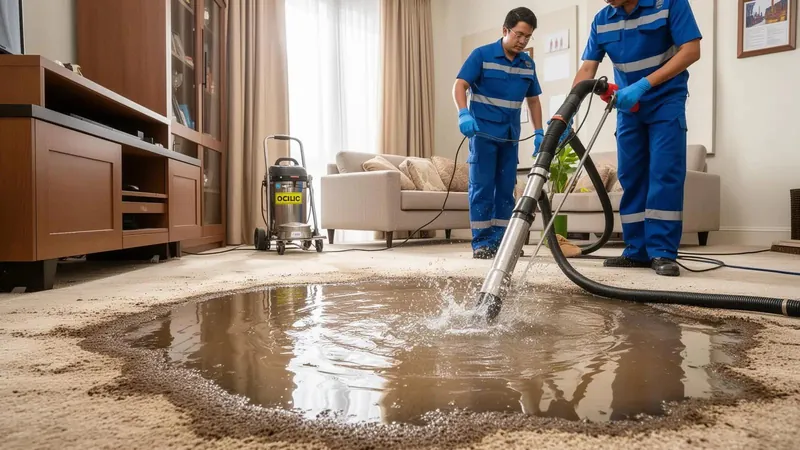
For burst pipe water damage in Dallas, shut off the main valve, open a low faucet, call a plumber, then a restoration provider. The EPA says to dry wet areas within 24 to 48 hours to prevent mold. Standard homeowners policies often cover the resulting water damage, not the pipe itself.
What should I do first when a pipe bursts in my Dallas house?
With burst pipe water damage in Dallas, the first job is to stop the flow. Turn off the closest valve to the break, or the main valve for the whole house if you cannot tell where the water starts. Then drain the lines at a low faucet, keep people off wet floors near outlets, and call a plumber.
- Close the shutoff. Use the valve nearest the leak, or the main valve for the house. If you cannot find either, the meter box near the street has a valve too.
- Cut power to wet areas at the breaker if you can reach the panel without stepping through water. Leave it alone if the panel is wet.
- Open the lowest faucet and a few others to release pressure and drain the lines.
- Stay out of an attic with dripping insulation or water on the framing. Wet insulation near wiring is a hazard.
- Photograph and film the break, the water and the damage before you move anything.
- Call a plumber for the repair, then a restoration provider for drying. See emergency water damage restoration for how that call works.
Do not start cleanup before the water is off. Clean water that keeps running will undo anything you dry.
Where is the shutoff valve in a slab house?
Most North Texas houses sit on a concrete slab, so the main valve is usually outside or in a utility space rather than below the floor. Look at an exterior wall near the front hose bib, in the garage, or beside the water heater. The city meter box has its own valve near the street.
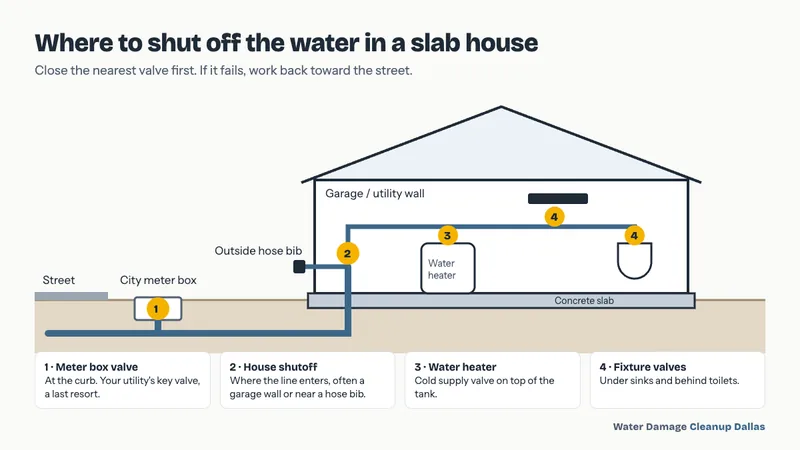
Find these before you need them. Touch each valve once a year so it does not seize, and tag the main with a bright label. If a valve will not turn, a plumber can replace it, and that is worth doing before the next hard freeze.
- House main: shuts off water to the whole home.
- Water heater valve: stops the cold feed so a tank leak does not keep refilling.
- Fixture stops: small valves under sinks and behind toilets for one fixture at a time.
- Meter box valve: a last resort when the house main fails. Ask Dallas Water Utilities who may operate it.
How can I tell where a burst pipe is leaking?
Watch where the water shows up, whether it is warm, and whether the sound of running water stops when you close the main. A ceiling drip points to an attic or upstairs line, a wet wall to a line in the cavity, and a warm floor spot to a pipe under the slab.
| Where it shows | Likely location | What to check |
|---|---|---|
| Ceiling stain or drip | Attic supply line, water heater, upstairs bath | Insulation and framing above the stain |
| Wet or bubbling wall | Line inside an exterior or interior wall | Baseboards, outlets and the wall on the other side |
| Warm floor spot, hissing sound | Pressurized line under the slab | The meter with every fixture off. See slab leak water damage |
| Soggy yard or wet exterior wall | Hose bib, irrigation line or a buried service line | The meter and the ground near the foundation |
| Water at the cabinet or toilet | Supply line or fixture stop | The braided hose or stop valve for corrosion |
A plumber has tools that find a hidden break without opening every wall. Methods and prices differ, so confirm what a visit includes before you agree to it.
Why do pipes burst in Dallas when it rarely gets cold?
Dallas is mild most winters, so many pipes sit in attics, garages and exterior walls with little protection. When a hard freeze arrives, water in those lines turns to ice, pressure builds, and the pipe splits. You often see the leak only after the thaw.
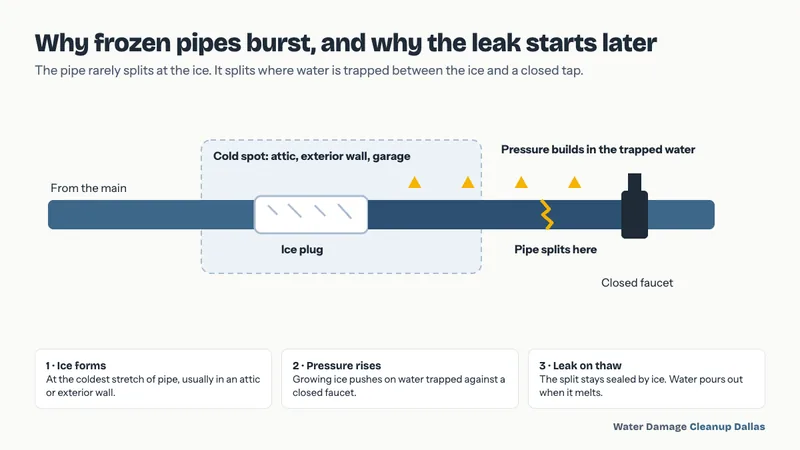
The National Weather Service Fort Worth office reports an average of 29.2 days a year with a low at or below 32 F at DFW Airport, with January the most frequent month. Most of those nights pass without damage. The ones that do not are the long, hard freezes, which the 2021 winter storm page covers.
The Red Cross says the pipes most at risk are supply lines in unheated interior spaces such as crawl spaces, attics, garages and kitchen cabinets. The frozen pipe prevention page lists what to do before a freeze.
What damage does a burst pipe do to a slab-on-grade home?
Water spreads across the flooring, soaks the bottom of the walls, and drops through ceilings if the break is above. On a slab there is no lower level to catch it, so water moves sideways under baseboards, into cabinets and under flooring. Wet drywall and insulation are the usual casualties.
- Flooring: carpet pad, laminate and hardwood swell or cup. See water-damaged floor repair.
- Drywall: it wicks water upward from the floor and sags when a ceiling holds water. See drywall water damage repair.
- Insulation: wet batts hold water against the framing and rarely dry in place.
- Cabinets and trim: particleboard swells and does not recover.
- Electrical: outlets and fixtures in a wet wall or ceiling need an electrician to check them.
IICRC's S500 standard classes a burst supply line as Category 1, or clean, water. That is the least contaminated category, but a provider can tell you whether the water has picked up anything along the way.
How fast does a burst pipe need to dry out?
Mold prevention is the clock here: the EPA puts the target at 24 to 48 hours for drying water-damaged areas and items. Treat that as the working goal after a burst pipe. Standing water has to come out first, then wet materials, then the air and framing get dried with fans and dehumidifiers.
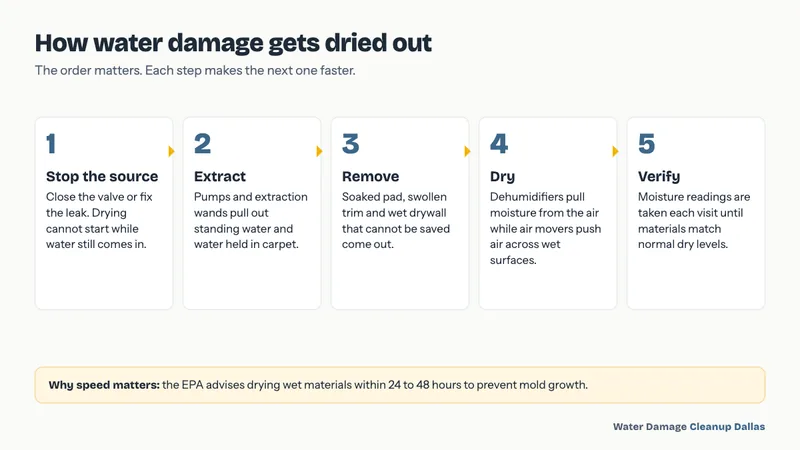
A restoration provider usually extracts the water, opens wet wall and ceiling sections where needed, and sets drying equipment. Providers differ in how they log progress, so ask what readings they take. The structural drying page explains the equipment, and water removal covers the first step.
Plan for the plumber first. Drying before the leak is fixed means the materials get wet again.
Does homeowners insurance cover a burst pipe in Dallas?
Often it does cover the water damage. Triple-I lists accidental discharge or overflow of water from plumbing, and freezing of those systems, among the named perils on standard forms. The pipe repair itself, a lack of maintenance and mold are treated differently, so read your policy.
The Insurance Information Institute puts the odds at roughly one in 60 insured homes filing a water damage or freezing claim in a given year. Its average for 2019 to 2023 was $15,400 per claim, across every cause, so yours may land elsewhere.
- Phone your insurer soon, and limit further damage while you wait.
- Keep receipts for emergency work and temporary repairs.
- Hold on to damaged items until the adjuster has visited.
- Collect written bids that itemize materials and costs.
The Texas Department of Insurance sets deadlines for insurers: about 15 days to acknowledge a claim, then 15 business days after receiving what they need to say yes or no. See the insurance claims guide for the full steps.
Can a burst pipe cause mold in a Dallas home?
Yes, if wet materials stay wet. The EPA says mold usually will not grow if damp materials dry within 24 to 48 hours. A burst pipe inside a wall or above a ceiling can hide water for days, so check the walls, baseboards and attic insulation after the repair.
For indoor air, the EPA recommends relative humidity under 60 percent, with 30 to 50 percent as the ideal range. The National Weather Service lists a normal annual relative humidity of 66 percent at DFW. Running the AC helps the room air, but it will not dry a wet wall.
- Musty smell after the repair means something is still damp. See water damage smell.
- A patch under roughly 10 square feet: the EPA says most homeowners can handle it.
- Larger or hidden mold: the EPA says not to paint or caulk over it. Read mold after water damage.
What if the burst pipe is outside or the water main?
A break outside the house, such as a hose bib, an irrigation line or a service line, can flood a yard and soak a foundation edge. A break on the street side is a city matter. Dallas Water Utilities says to report main leaks and breaks by calling 3-1-1 or using Dallas 311 online or the 311 app.
Dallas Water Utilities manages just over 5,000 miles of water mains and names dry, expansive soil and high demand as contributors to breaks. That is a public-system problem, but it can still affect the yard and the meter. Which part of the line belongs to the homeowner is not something this site can state, so ask the utility.
- Shut off the house main if water is entering the home.
- Photograph the water and the meter box.
- Report a street leak to 3-1-1 so the city can dispatch.
If the water came in as outside surface or flood water instead of from a pipe, the IICRC treats it as Category 3 and standard homeowners policies exclude flood. See flood cleanup.
How do I choose help after a burst pipe?
Call a plumber to fix the pipe, and a restoration provider to dry what got wet. This site is a referral service, not a contractor, and connects you with independent providers. Availability, methods and prices differ, so confirm the details directly before you sign anything.
- Ask what the visit includes: extraction, equipment, moisture readings and a drying log.
- Get the scope in writing before work starts. Read the work authorization guide.
- Ask how they bill and whether they work with your insurer.
- Keep your own photos and the plumber's report for the claim.
The guide to choosing a restoration company has more questions to ask. For what the work can cost, see restoration cost.
Sources: Red Cross frozen pipes page; NWS DFW normals; IICRC S500; EPA mold and moisture guide; EPA mold cleanup; Triple-I covered perils; Triple-I claim settling; III homeowners facts; TDI claim steps; Dallas Water Utilities news on main breaks.