The short version
With bathroom and kitchen water damage in Dallas, close the fixture valve or the main shutoff, turn off power near wet outlets and photograph everything. A plumber fixes the failed part, and a restoration provider dries what is wet. Drying wet materials in the first 24 to 48 hours, as EPA guidance urges, helps prevent mold.
What should I do first when a bathroom or kitchen leaks?
Close the valve that feeds the leaking fixture, and if it will not turn, close the main shutoff for the house. Then protect people and wiring, and document the damage before you wipe anything up. Bathrooms and kitchens hold more plumbing per square foot than any other rooms, so a small failure can spread fast.
- Shut the fixture valve. Toilets and sinks have a small oval or round stop valve on the supply line. Turn it clockwise until it stops.
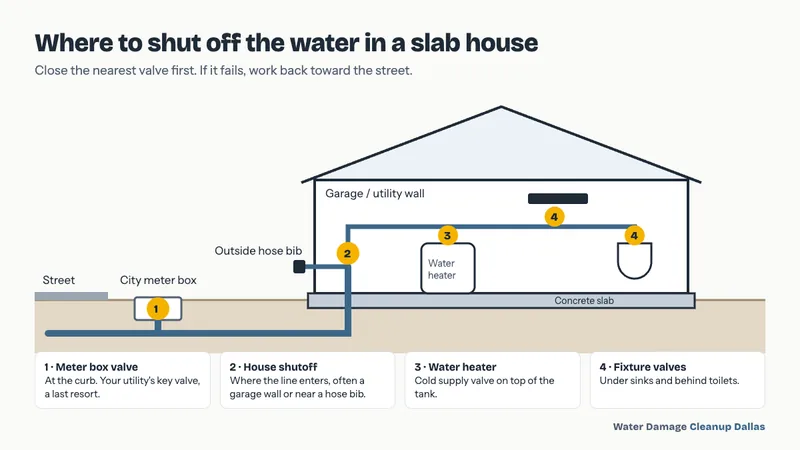
- Close the main shutoff if the stop valve is stuck, corroded or the leak is inside a wall. The diagram below shows common shutoff spots in a slab house.
- Turn off power to the room at the breaker if water is near outlets, a dishwasher or a range, if the panel is dry to reach.
- Photograph and film the fixture, the path of the water and every wet surface, floors and cabinet bases included.
- Blot standing water, lift rugs and bath mats, and empty the cabinet under the sink so the base can be checked.
- Call a plumber for the failed part and a restoration provider for the wet materials.
Drying and repair are separate jobs, and water damage repair in Dallas explains how they fit together. Providers differ, so confirm directly what each one will assess and how it works.
Where do bathrooms and kitchens usually leak, and what water category is it?
Each fixture fails in its own place and puts out its own kind of water, which decides how wet materials are handled. The IICRC S500 standard sorts water into three categories. Supply lines and burst pipes give Category 1 (clean), and a washer, a dishwasher or a toilet that overflows with no waste in it gives Category 2 (grey).
| Source | Common failure point | First shutoff | Water category (IICRC S500) |
|---|---|---|---|
| Toilet | Supply line, fill valve, tank bolts, wax seal at the base | Stop valve on the wall behind the bowl | Cat. 1 from supply; Cat. 2 from overflow without waste |
| Shower or tub | Cracked grout, failed caulk, worn pan, drain connection | Stop using it; the house shutoff for a hidden leak | Category 1 from supply; Category 2 if the drain is involved |
| Bathroom or kitchen sink | Supply lines, P-trap joints, faucet base, sprayer hose | Two stop valves in the cabinet below | Category 1 from supply; Category 2 from drain |
| Dishwasher | Door seal, inlet fitting, drain hose | Valve under the kitchen sink | Category 1 from supply; Category 2 from discharge |
| Refrigerator water line | Thin tube and fittings behind the unit | Small valve on the line | Category 1 from supply |
| Pipe inside a wall | Joints, corroded sections, a freeze split | House shutoff | Category 1 at the start |
Water with waste in it is Category 3, covered under sewage backup cleanup. Appliance leaks go deeper on dishwashers.
What happens when a toilet overflows or leaks at the base?
An overflow spreads across the floor in minutes and can pass through the subfloor in a two-story house. A slow leak at the base is quieter and more harmful, because the wax seal drips into flooring and never shows. Tell the two apart before deciding who to call.
When the bowl backs up and clean-looking water spills, close the stop valve behind the toilet and stop flushing. A clog that sends up waste is a drain problem, and anything that carries waste is Category 3, not an ordinary leak.
Signs of a base leak include a floor that feels soft near the toilet, a rocking bowl, stained caulk and flooring that lifts at the edges. Do not caulk over a wet area. A plumber replaces the seal, and a restoration provider reads moisture in the floor so the repair is not built on damp wood.
How does a shower or tub leak damage floors and walls?
Water escapes through failed grout, caulk or a worn pan and soaks the wall behind the tile and the floor beneath it. The damage stays hidden for months, because the surface looks fine while the backer board and framing hold water.
Watch for loose or cracked tiles, grout that stays dark, a soft spot near the tub edge, paint that bubbles on the wall next to the shower and a stain on the ceiling below an upstairs bathroom.
- Test the caulk line where the tub or shower meets the wall. Gaps there let water behind the surface.
- Press on the tile near the base. A flex or a hollow sound suggests the backing is wet.
- Check the adjoining room. A wet wall on the other side of the shower points to a leak in the shower wall.
Tile showers are often opened from the back or the side so the wet backer can be removed. A repair contractor decides the scope after moisture readings. The drywall water damage repair page explains how wet board is cut out and replaced.
What about a leaking sink or supply line under the cabinet?
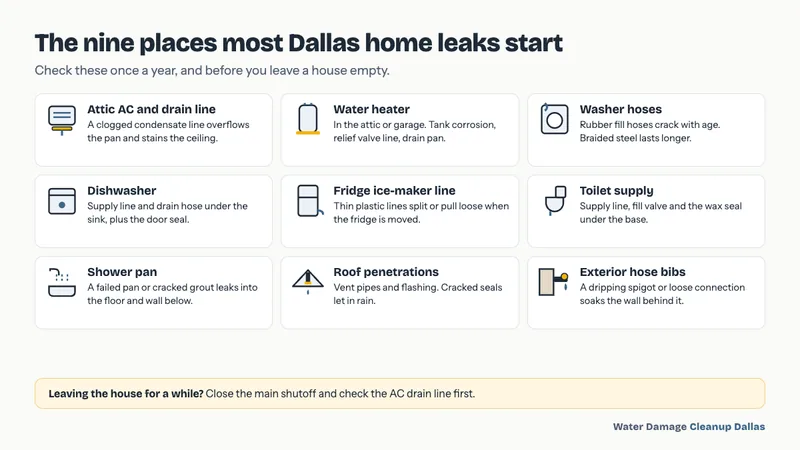
Most sink leaks come from supply lines, P-trap joints and the faucet base, and they drip into the cabinet where nobody looks. A pinhole in a supply line can run for weeks. The cabinet floor wicks it up, swells and eventually shows through to the room.
Open the cabinet doors and look with a flashlight at the valves, the connections, the trap and the cabinet floor. Run the water for a minute with a dry paper towel held under each joint.
A drip at a compression nut often needs a plumber to replace the line. Braided supply lines are a common upgrade, though a plumber can say what suits your fixtures. A claim goes better with evidence, so shut the valve and take photos first.
Can a wet kitchen cabinet or vanity be saved?
Sometimes, depending on the material and how long it stayed wet. Solid wood and plywood boxes can often dry. Particleboard and fiberboard swell, crumble and rarely return to shape. A restoration provider can measure the cabinet base and tell you which case you have.
Cabinet floors are the weak point because they sit on top of the flooring and trap moisture beneath. Providers sometimes remove a kick plate, drill small holes or pull a section of flooring so air can reach the wet area.
Mold can start fast, and EPA guidance puts the target for drying wet areas and items at 24 to 48 hours. For cost context, Fixr lists national restoration costs of $1.50 to $3 per square foot for drywall and $10 to $15 for hardwood. Those are national figures, and Dallas jobs vary, so get written estimates. The floor repair page covers what happens to flooring under cabinets.
Why does an upstairs bathroom leak show up in the ceiling below?
Water follows gravity. It drops through the floor framing and spreads along joists before it reaches the ceiling, so the stain often appears a few feet from the real leak. A bulge or a brown ring below an upstairs bathroom is usually a sign that the subfloor is already wet.
Do not poke a bulging ceiling without a plan. Water can hold weight in the drywall, and a sudden release floods the room. Move furniture, set a bucket under the lowest point, and read the ceiling water damage repair page for the safe drain method.
If a stain returns after it dries, the source is still active. Shower valves, supply lines in the wall and drain joints can all drip only when used, so a stain that comes and goes during the week is worth tracing with a plumber.
How do I find a bathroom or kitchen leak I cannot see?
Start with the water meter. If every fixture and appliance is off and the meter still moves, water is escaping somewhere. Then narrow it down by checking each fixture, each valve and each wall that shares plumbing with the wet area.
- Meter check: the water meter leak test walks through reading the dial with everything off.
- Sound: listen near the walls for hissing or trickling when nothing is running.
- Touch: a cold, damp spot on a floor or a wall can mean a supply line behind it.
- Smell: a damp odor that returns after cleaning points to wet materials. See water damage smell.
- Bills: a bill that climbs while your habits stay the same is a clue.
If the leak is under a slab, the pattern is different. Warm spots in the floor and the sound of running water point there, and the slab leak page covers it. For the full list of warning signs, read signs of water damage in a Dallas home.
Does insurance cover bathroom and kitchen water damage?
Often, if the failure was sudden and accidental. Triple-I lists a sudden burst or overflow from plumbing, heating, cooling or an appliance as a named peril on standard forms. Only your own policy can say for certain, so read it or call your agent before you count on a payout.
Triple-I adds two limits. Neglected maintenance is excluded, so a seal that dripped for months may be disputed, and a sewer backup needs its own endorsement or product rather than a typical homeowners policy.
Plumbing leaks are typically covered, says the NAIC, but ground water and rain runoff are not. Texas insurers work to deadlines posted by the Texas Department of Insurance, and a rejection has to come with reasons in writing. Keep the failed part, save receipts and photograph everything. Insurance Information Institute data show roughly one in 60 insured homes with a water damage or freezing claim each year, and a $15,400 average for 2019 through 2023. The insurance claims guide covers the process step by step.
Who do I call, and what should the provider check?
Call a plumber for the failed part and a restoration provider for the wet materials. The plumber fixes the source so the leak does not return, and the provider extracts water, measures moisture and dries what can be saved. This site refers callers to independent providers and does not do the work itself.
Ask each provider directly what it will check and how it documents the job. Useful points to raise:
- Whether moisture readings will be taken in walls, cabinet bases and floors, and whether you will see them.
- How it handles Category 2 water and anything that touched a drain.
- What it will write down before work starts. See the work authorization guide.
- How drying is monitored. Structural drying explains the readings.
Providers differ in what they offer and when they can arrive, so confirm each point on the phone. The guide to choosing a restoration company lists more questions.
How do I prevent the next bathroom or kitchen leak?
Look at the weak points on a schedule and fix small problems before they become wet floors. Most of these checks take minutes. Do them at the start of each season and before you leave for a trip.
- Re-caulk tub and shower edges when the line cracks or pulls away.
- Inspect supply lines under sinks and behind toilets for bulges, rust and drips.
- Test stop valves once a year so they turn when you need them.
- Add leak sensors beside the dishwasher, under sinks and next to the toilet, and replace their batteries.
- Keep the cabinet floor dry and clear so a slow leak is easy to see.
In a hard freeze, a pipe in an exterior wall behind a sink can split, which is the point of the frozen pipe prevention guide. The prevention guide has the longer list, and water mitigation explains what happens after a leak has already soaked the room.
Sources: water categories, IICRC S500; covered perils, maintenance and sewer backup limits, Triple-I; claim frequency and average cost, Insurance Information Institute; plumbing versus runoff, NAIC; insurer deadlines, Texas Department of Insurance; drying window, EPA; national repair costs, Fixr.