The short version
For apartment water damage in Dallas, the building owner insures the structure and your renters policy covers your belongings, per TDI. Flood is excluded from standard renters policies. Report the leak to the landlord in writing, photograph everything and call your insurer before you move or throw anything away.
Who pays when an apartment has water damage in Dallas?
It depends on what was damaged. The building owner's insurance pays for the building, and your renters policy, if you have one, pays for your belongings. The Texas Department of Insurance (TDI) says renters insurance covers your property but will not pay to fix the apartment building.
That split drives most arguments after a leak. A tenant sees a ruined ceiling and a ruined couch and assumes one party owes both. In practice the landlord handles the structure, and the tenant handles personal property through their own policy.
This site is a referral service, not an insurer, a landlord or a contractor, so it cannot decide who owes what in your lease. The sections below cover the general rules in Texas and where to look for the rest.
Does renters insurance cover water damage in a Dallas apartment?
It covers your clothes, furniture and other belongings when a covered event damages them, such as a pipe that suddenly bursts. It does not cover the building, flood water or, usually, a sewer backup. Read your policy, because the wording and the dollar limits decide each claim.
| What was damaged | Who usually pays | Source |
|---|---|---|
| Your furniture, clothes and electronics | Your renters policy, if the cause is covered | TDI home insurance guide |
| Walls, floors, ceilings and plumbing | The building owner's policy | TDI home insurance guide |
| Flood water from a storm or creek | A separate flood policy, not standard cover | Triple-I and the Texas lease flood notice |
| Sewer or drain backup | An add-on or separate product | Triple-I |
| A neighbor's property that you damaged | The liability part of your policy, where it applies | TDI home insurance guide |
Triple-I adds that flood damage is excluded from standard homeowners and renters policies. The lease flood notice in Texas law says the same thing in plain terms: most tenant policies do not cover flood damage.
The insurance claims guide explains deadlines and what insurers must do after you file.
What should a tenant do first after a leak?
Stay clear of the water, protect your belongings, document everything and tell the landlord in writing. Do these things before you hire anyone, sign anything or move out. The order below keeps both your insurance claim and your position under the lease intact while the building owner responds.
- Make it safe. Keep away from wet outlets and sagging ceilings, and leave if the water came from a sewer or a flood.
- Close the fixture valve if the leak is yours and you can reach it. Otherwise tell the property manager at once.
- Photograph and film the damage and your belongings before moving anything.
- Send a written notice to the landlord or manager and keep a copy with the date.
- Call your renters insurer. Triple-I advises contacting your company immediately and keeping receipts for emergency spending.
- Lift belongings off wet floors and keep damaged items until the adjuster has seen them.
The emergency water damage page describes what happens once a restoration provider arrives. Providers differ, so confirm details directly.

What does a Texas landlord have to tell me about flooding?
Property Code 92.0135 makes landlords disclose two things in writing: whether they know the rental sits in a 100-year floodplain, and whether it flooded in the last five years. House Bill 531 created the rule for leases signed or renewed on or after January 1, 2022.
Here is what the enrolled text of HB 531 says:
- An unchecked floodplain box means you should assume the dwelling is in a 100-year floodplain.
- Tenants are pointed to FEMA's flood map, which can be searched by address at no cost.
- The past-flooding notice is required when the landlord knows of a flood within the last five years.
- When a landlord breaks the rule and the tenant loses a large share of personal property to flooding, the tenant may end the lease in writing by the 30th day after the loss. Prepaid rent comes back within 30 days.
A later bill, SB 2349 (2025), adds exemptions for leases under 30 days and requires both parties to sign the notice. Check the current statute text before relying on either version.
Who has to fix the leak or the mold in my apartment?
The building owner is generally the one who repairs the structure and the plumbing inside walls. Put every repair request in writing and keep a dated copy. Texas has a landlord repair statute in Property Code chapter 92, and a legal aid group or the statute itself can tell you what it requires in your case.
Mold needs its own caution. The Texas Department of Licensing and Regulation (TDLR) says it regulates mold work that affects indoor air quality, but does not do assessments or remediation and cannot force a landlord to remove mold.
TDLR's FAQ says visible mold under 25 contiguous square feet can usually be cleaned by unlicensed people. The CDC says mold can cause a stuffy nose, coughing, wheezing and burning eyes, and people with asthma or mold allergy may react severely. See mold after water damage.
What changes if I own a condo in Dallas?
You own the interior of your unit, so your condo policy matters much more than a renter's does. TDI says condominium insurance covers your personal property and the interior of your unit, provides liability protection and pays additional living expenses. The association's master policy is a separate question.
Ask your association or manager three things before a leak happens:
- What the master policy covers, and which parts of the building it leaves to you.
- Who handles shared plumbing, roof and exterior walls, and how to report a problem.
- What your deductible is, and whether your policy has an add-on for sewer or drain backup.
TDI notes the same split for townhouses: when the association's master policy covers the exterior, you can buy a policy for the interior only. Rules differ by building, so read your declarations and the association documents.
If you must move out while repairs run, see loss of use coverage for how living expenses work.
What if the water came from the unit above mine?
Treat it as a building problem and a liability question. Report it to the manager in writing, photograph the source and the damage, and call your own insurer. The upstairs unit's cause decides who may owe you, and that is settled between insurers or in a dispute, not by guesswork.
Water type also changes the cleanup. Under IICRC S500, a supply line break is Category 1 clean water, an appliance or toilet overflow without waste is Category 2, and sewage is Category 3. The ceiling water damage page covers stains and sagging.
TDI says the liability part of a home policy pays when you are responsible for damaging someone else's property, and condo policies include liability protection. Ask your agent whether yours applies if your own appliance flooded a neighbor.
How soon does a wet apartment need to dry?
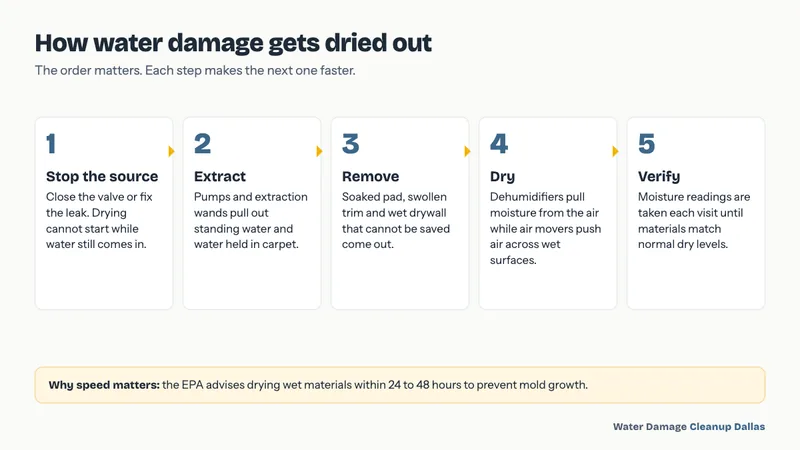
Aim for a day or two. The EPA's mold guide sets 24 to 48 hours as the window for drying wet areas and items. The CDC uses the same window after a flood and adds that soaked carpet and upholstery you cannot dry quickly should come out.
In an apartment you rarely control the walls, so speed depends on the landlord. Send the written notice first, then keep moving belongings off damp floors and ask whether the management company has a restoration provider on call.
Dallas air is not dry. The National Weather Service lists a 66 percent annual normal relative humidity at DFW Airport, so do not count on open windows alone.
How does a restoration provider get involved in a rental?
Usually the building owner or manager authorizes work on the structure, while you authorize work on your own belongings. Providers differ in how they bill and what they need signed, so ask who the work order names before anyone starts.
- Read before signing. The work authorization guide covers what a signature commits you to.
- Separate the bills. Structure is the landlord's cost, and contents are yours. See contents cleaning and pack-out.
- Compare costs. The cost guide lists national ranges, not Dallas quotes.
When you are ready, the contact page connects you with a restoration provider, and the choosing guide helps you compare them.
Sources: TDI, home insurance guide (renters, condo and townhouse coverage); Triple-I, covered disasters; Triple-I, settling claims; Texas Legislature, HB 531 (2021) enrolled text; Texas Legislature, SB 2349 (2025) enrolled text; TDLR, mold assessors and remediators at a glance; TDLR, mold FAQ; CDC, about mold and your health; EPA, mold and moisture guide; IICRC, S500 standard; National Weather Service Fort Worth, DFW records and normals.