
The short version
Expect a water damage smell in Dallas to be damp and earthy: wet materials, or mold just beginning. Fresheners only cover it. Trace the source, stop the water and dry the area, aiming for the 24 to 48 hours the EPA gives. Sewage odor is a separate case for a professional.
What is that damp smell in my house, and is it water damage?
Usually yes, or at least a sign of moisture. Water damage smells damp, earthy and stale, like a closet where wet towels were left. It comes from materials that stayed wet long enough for mildew to start, or from water that is still collecting out of sight.
People describe it differently: a sour tang from carpet, wet cardboard near a wall, a faintly sweet rot from a ceiling. Each description points to moisture that has not left the building. Treat the smell as a lead to follow, not as a verdict.
This site refers callers to independent providers and does no restoration work itself, so the guide covers what each smell suggests and what to check first. On a Dallas slab house, the likely hiding places are the attic, wall cavities and flooring.
Is a musty odor proof of mold?
Not by itself, though it justifies a search. Something damp is giving off the odor, and the EPA brief guide ties mold growth to moisture. After a leak, a hailstorm or a long summer of cooling, assume a wet spot exists until you show otherwise.
Odor without visible mold is common. Growth often starts behind drywall, beneath flooring or inside insulation, where you cannot see it. A smell can also come from bacteria in wet carpet pad, and no mold at all.
Visible mold changes the plan. The mold after water damage guide covers what to inspect, what a homeowner can clean and when to hire help.
Which smell points to which source?
Match the odor you notice to the rows below, then confirm with your eyes and hands. The table shows common patterns rather than lab findings, and a single house can carry two odors at once.
| Smell | Likely source | First check |
|---|---|---|
| Damp and earthy in one room | Wet drywall, insulation or flooring after a leak or storm | Press on baseboards and walls; look at the ceiling above |
| Musty only while the AC runs | A clogged condensate line, a wet pan or damp ductwork | Look at the air handler. See AC leak water damage |
| Sour, like wet laundry | Carpet and pad that stayed wet too long | Lift a corner and smell the pad. See wet carpet drying |
| Sharp, sewage-like | A backed-up drain, a broken line or contaminated water | Keep people and pets out. See sewage backup cleanup |
| Rotten egg at one drain | Often a dry or fouled trap; a plumber can confirm | Run water for a minute; if it stays, call a plumber |
| Stale or rotting, from a wall or ceiling | A slow leak in a wall cavity or soaked insulation | Look for stains and soft spots. See signs of water damage |
Be careful with the rotten egg row, because gas utilities add a similar odor to natural gas. When the smell fills the whole house instead of one drain, get everyone outside, leave light switches alone and phone the gas company from there.
Why does the AC make my house smell damp?
Cooling air produces water. The coil pulls moisture out of the air, and a condensate drain line carries it away. When that line clogs, the pan overflows onto insulation and ceiling board, and the blower then pushes the damp odor out through every vent.
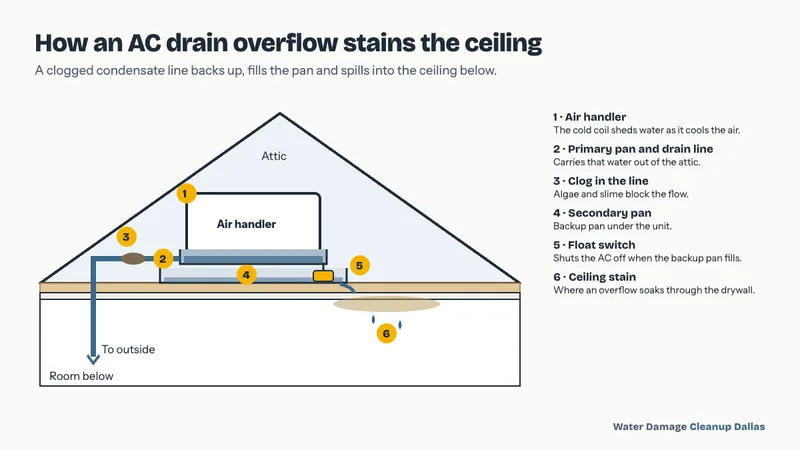
North Texas gives cooling systems plenty of work. The National Weather Service normals for DFW Airport list 20.2 days a year at or above 100 F, and a system that runs hard makes more condensate.
Turn the system off at the thermostat if you see a stain or water near the unit. An HVAC technician can clear the line and inspect the pan. Then read the ceiling water damage repair page for wet drywall, and AC leak water damage for the full cause list.
Why is the smell back a week after I cleaned?
The source is probably still wet. Wiping a surface leaves the material under it damp, so the odor returns as humidity climbs. Typical reasons are a slow leak nobody fixed, insulation or subfloor left in place, and a clean surface sitting on wet material.
Revisit the table above, and record the room's humidity once a day for a week. A reading that stays over the 60 percent mark the EPA gives, even after surfaces feel dry, means the building is storing water or still taking some in.
A smell weeks after a flood often means part of the drying was skipped. The CDC calls for full, fast drying in 24 to 48 hours and for removing soaked carpet and upholstery that cannot dry quickly. On hard surfaces it accepts household cleaner, soap and water, or up to a cup of bleach per gallon of water, never combined with ammonia. Do not paint or caulk over mold, says the EPA.
Can I smell water damage inside a wall, the attic or under the floor?
Yes, though pinning the location takes patience. Odors travel through gaps, ducts and wall cavities, so the strongest spot is not always the source. Move through the house with the AC off and windows closed, and note where the smell is strongest.
- Walls: a stale or sweet smell near an outlet, baseboard or bathroom wall points to a wet cavity. Check the room on the other side too.
- Attic: a damp, woody smell near the hatch can mean a roof leak or a leaking air handler pan. See roof leak and storm water damage.
- Under a floor: a smell that is strongest at floor level, plus a warm or soft spot, suggests a leak beneath it. The slab leak page lists the signs.
- Cabinets: open the sink cabinet and smell the base. See bathroom and kitchen water damage.
Hidden water seldom stays hidden for long if you check the water meter. With everything off, a moving dial means a leak. The water meter leak test shows how.
What does a sewage or sulfur smell mean?
A sharp sewage or rotten egg odor suggests waste water or a drain fault rather than a plain leak. Possible causes include a dry trap in a drain nobody uses, a blocked line or a backup. A backup is a health matter and needs a professional.
Where sewage or other contaminated water caused the damage, the EPA tells owners to bring in a professional experienced with such buildings. The IICRC S500 standard puts sewage and rising river or stream water in Category 3.
Keep people and pets out of the affected rooms, do not run fans that move air through the house and do not try to scrub it clean. The sewage exposure and health page explains the risks, and the sewage backup cleanup page covers what happens next.
How do I trace the smell to its source?
Start where the odor is strongest and test each suspect in turn. Check the places water gets in most often: the ceiling beneath an attic air handler, walls beside bathrooms, cabinet bases and the floor around appliances. A flashlight, a dry paper towel and a notebook are all you need.
- Note when it happens: all the time, only with the AC on, or after rain or a shower.
- Check the usual spots: the attic pan and drain line, under every sink, behind the toilet and the fridge.
- Press and look at baseboards, cabinet floors and drywall for soft or discolored spots.
- Read humidity in the room with a hygrometer and compare it to a dry room.
- Check the meter with all water off for a hidden supply leak.
- Photograph what you find, in case you need it for an insurance claim.
If none of that finds it, a provider with moisture meters can trace wet materials without opening everything up. Ask each provider what it will check and what it will give you in writing. For other clues to watch for, see signs of water damage in Dallas.
Will air fresheners, bleach or a dehumidifier remove the smell?
They help only after the water is gone. Fresheners cover the odor, bleach only treats a hard surface, and a dehumidifier lowers humidity without drying the wet materials inside a wall. None of them replaces finding and fixing the source.
- Air fresheners: hide the smell while the cause keeps growing.
- Bleach: the CDC lists it only for hard surfaces and only in a weak mix. Porous materials like carpet pad and drywall usually need removal instead.
- Dehumidifiers: useful after the leak is fixed. Dallas air is not dry, since the NWS lists 66 percent annual relative humidity at DFW Airport.
- Air movers: a provider uses them as part of structural drying, with readings to show when materials are dry.
Do not mix cleaners. Chemical fumes in a closed room add a second problem.
Should I worry about my health with a damp smell?
Take it seriously if the smell is strong, follows a flood or sewage, or makes someone in the house feel unwell. The CDC links mold to a stuffy nose, sore throat, cough or wheeze, burning eyes and skin rash. Asthma or mold allergy can intensify these, and weak immune systems or chronic lung disease raise the risk of lung infections.
Move people with asthma, allergies or a weak immune system away from the area until it is dealt with. See a doctor for symptoms that persist.
A smell alone does not show that a hazard exists, and no web page can diagnose one. The practical step is to find the moisture and remove it. The next section covers what Texas expects for mold work.
Do I need a mold test or licensed mold work in Texas?
Not for a small patch. A moldy patch smaller than about 10 square feet, the EPA says, is in most cases a job you can do yourself. Texas rules for licensed mold work have their own exemptions, and a smell with no visible mold is a moisture question first.
The Texas Department of Licensing and Regulation says mold projects of less than 25 square feet are exempt from its licensing rules, and that it does not do assessments or remediation itself. A licensed remediator must notify the state at least five days before starting a project. Exemptions also cover owners of one or two family homes during construction and renovation. TDLR does not force a landlord to remove mold.
Rules and exemptions differ by project type, so ask a licensed assessor or TDLR before you rely on any threshold for your home. The apartment and condo page covers renters and shared walls.
Who should I call about a smell I cannot find?
Phone a restoration provider if you cannot locate the source, the odor followed a flood or sewage, or you suspect water inside walls or beneath flooring. Do it early, because the EPA's drying window runs 24 to 48 hours, and an odor that lingers suggests it has already passed.
Find out what each provider actually offers, such as moisture checks, drying or odor treatment, and ask for readings with photos. When a drain or supply line is to blame, a plumber is also needed. Providers reached through this site set their own terms.
Water you can see or step in is a job for emergency water damage restoration. Cost questions go to water damage restoration cost in Dallas.
Sources: humidity, drying window and small mold patches, EPA, Brief Guide to Mold, Moisture and Your Home; contaminated water and painting over mold, EPA, Mold Cleanup in Your Home; health effects and cleaning, CDC, About Mold and Your Health; water categories, IICRC S500; Texas mold licensing, TDLR, Mold Assessors and Remediators at a Glance; TDLR, Mold FAQ; temperature and humidity normals, NWS Fort Worth/Dallas.