The short version
For vacation rental water damage, check the water heater, AC drain, sinks, toilets and ceilings at every turnover and label the shutoffs. TDI says most home policies will not pay for losses during short-term rentals, so ask your agent about cover before a loss. Dry wet areas in 24 to 48 hours.
Why does vacation rental water damage go unnoticed so long?
Nobody lives there. A guest may notice a drip and say nothing, a leak can start the day after checkout, and an empty unit has no one to hear a running pipe. A host who checks on a routine catches problems while they are still small and cheap.
The cost of a miss is real. Industry group Triple-I says average severity for water damage and freezing claims was $15,400, averaged over 2019 to 2023.
This page is for hosts of short-term rentals in the Dallas area. This site is a referral service, not a contractor or an insurer, so the checklist is general advice drawn from public sources. Most North Texas houses sit on slabs, so a hidden leak often runs under the floor or inside a wall instead of dripping into a lower level.
What should I check between every guest stay?
Walk the same route each turnover: the water heater, the AC area, every sink and toilet, the washer, the ceilings and the air. A five-minute pass catches most trouble. Write the route down so every cleaner or co-host follows it, and photograph anything odd with the date.
| Check | Where to look | What it may mean |
|---|---|---|
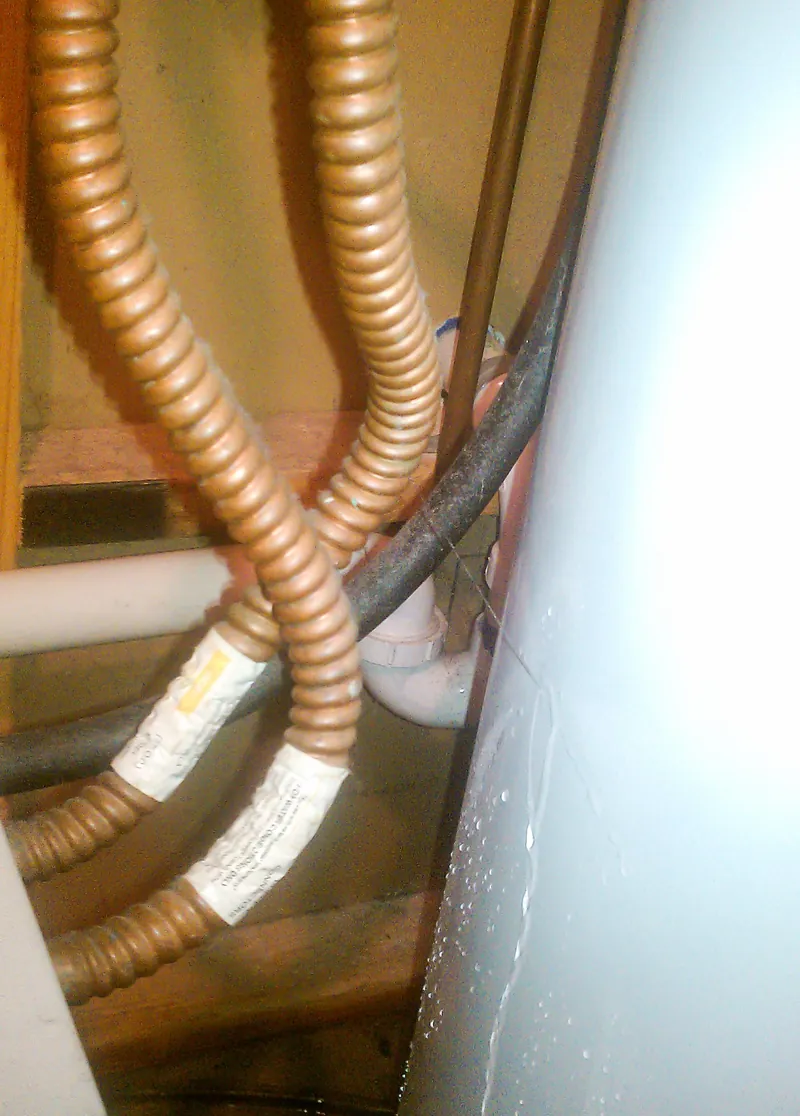
| Water heater | Base, relief valve, supply lines, drain pan | Rust, drips or a wet pan point to a failing tank or fitting |
| AC drain pan and line | Attic or closet air handler, ceiling below | Water in the pan or a new ceiling stain points to a clogged condensate line |
| Under sinks and behind toilets | Supply lines, stops, cabinet floor | Damp wood or a swollen cabinet base shows a slow leak |
| Washer and dishwasher | Hoses, connections, floor behind | Bulging hoses or a damp floor shows wear |
| Ceilings and walls | Brown rings, bubbling paint, soft spots | Water has moved from a source above or inside |
| Air and humidity | Musty smell, foggy windows | Hidden moisture or a mold start |
A general turnover checklist. Adjust it to the house you manage.
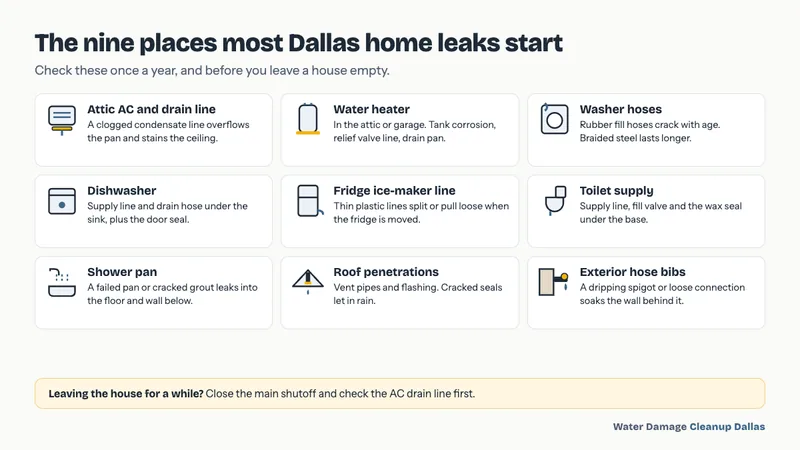
Details on the biggest culprits live on the water heater leak page, the AC leak page and the appliance leak page.
How do I protect an empty rental from a slow leak?
Know where every shutoff is, close the water when the unit will sit empty for a long stretch, and add leak sensors that alert a phone you actually watch. The National Weather Service says DFW averages 20.2 days a year at or above 100 F, so the AC works hard and drain lines clog.
- Label the main shutoff and the water heater valve, and tell your cleaner where they are.
- Put sensors under the water heater, behind the washer, by the dishwasher and in the AC drain pan.
- Route alerts to more than one person, so a missed notification does not mean a missed leak.
- Ask a plumber whether an automatic shutoff valve suits the house.
- Ask an HVAC technician about a float switch on the air handler.
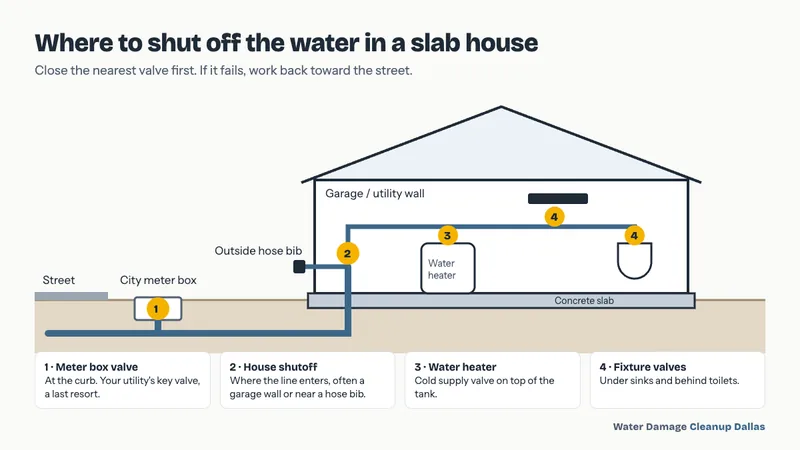
If your water bill jumps between bookings, the water meter leak test shows whether water is moving with every fixture off.
What should guests be told about leaks?
Put a short, plain note where guests will see it: where the water shutoff is, who to call, and what to do first. Guests are more likely to report a problem if the instruction is easy and they do not fear blame. A clear note can save an entire night of water running.
- Give the shutoff location in the house manual, with a photo.
- Ask guests to close the fixture valve if a toilet or sink is overflowing and they can reach it.
- Ask for a photo and a text before anything else.
- Tell them to stay out of wet rooms and away from wet outlets.
- List a number for you or your property manager that someone answers.
Use the same wording across your listing, the lockbox message and the welcome binder, so there is only one instruction to follow.
What do I do when a guest reports a leak?
Get the water stopped, get people to a dry space, document the damage and call your insurer before you throw anything away. Move quickly, because wet materials turn into mold problems fast. The EPA advises drying water-damaged areas and items within 24 to 48 hours.
- Stop the source. Close the fixture stop, or the house shutoff, and call a plumber for the repair.
- Check safety. Keep guests away from wet outlets, sagging ceilings and sewage. Offer another room or a refund discussion if the unit is not livable.
- Photograph and film the damage, the source and the date.
- Report the loss. Triple-I advises contacting your insurer immediately and making only reasonable temporary protection before the adjuster visits.
- Start drying. A restoration provider can extract water and set equipment while the claim moves.
The emergency restoration page explains a first visit. If a guest also made a claim about their belongings, keep your own records of what was damaged.
Does insurance cover a leak in a short-term rental?
Often not without extra cover. The Texas Department of Insurance (TDI) says most home policies will not pay for damages or injuries that occur during short-term rentals, and tells hosts to ask their agent whether they are covered and whether to buy more. Ask before the first booking, not after a loss.
Several other policy terms matter for a rental house that sits empty between stays:
| Question for your agent | Why it matters | Source |
|---|---|---|
| Does my policy apply while guests stay? | Most home policies do not pay for losses during short-term rentals | TDI home insurance guide |
| What does it say about vacant periods? | Most policies do not cover losses if the house is vacant for the number of days the policy names | TDI home insurance guide |
| Is a slow leak excluded? | Most policies do not cover a continuous water leak or lack of maintenance | TDI; Triple-I |
| Do I have sewer backup cover? | It is usually an add-on or a separate product | Triple-I |
| What happens if a guest damages the property? | The guest's own policy might cover it; ask both sides | TDI home insurance guide |
TDI's home insurance guide covers each of these points. The insurance claims guide covers the claim steps and the Texas deadlines.
How do I keep a rental safe through a North Texas freeze?
Hold a steady indoor temperature, let faucets on exposed pipes drip, and ask someone to look in during the cold. For an unoccupied home the Red Cross sets a floor of 55 F on the thermostat, left unchanged through day and night.
North Texas learned this in February 2021. The National Weather Service says DFW Airport spent 139 consecutive hours at or below freezing. Pipes in attics, garages and kitchen cabinets are the ones most exposed, according to the Red Cross.
A rental adds a wrinkle: a guest may lower the thermostat, or nobody may be home. Consider blocking bookings during a hard freeze, and read the frozen pipe prevention guide. The February 2021 page describes what that storm did.
How do I stop mold from growing between bookings?
Dry quickly and watch humidity. The EPA recommends indoor relative humidity under 60 percent, with 30 to 50 percent ideal. Dallas air is humid, since the National Weather Service lists a 66 percent annual normal at DFW Airport, so keep the AC running and consider a dehumidifier in an empty unit.
- Check for a musty smell on arrival at each turnover.
- Look at ceiling corners, closet walls and under-sink cabinets.
- Never paint or caulk over mold, the EPA says.
- For a patch smaller than about 10 square feet, the EPA says most owners can handle it themselves. Bigger jobs call for a professional.
The CDC says mold can cause coughing, wheezing and burning eyes, and people with asthma may react severely. That is a guest safety question as well as a repair one. See mold after water damage and water damage smells.
When should a host call a restoration provider?
Call when water has reached more than a small area, when the water was not clean, or when materials stayed wet past a day or two. A provider can extract water, set drying equipment and take readings. Providers differ on timing and billing, so confirm details directly.
Do not wait on sewage or outside flood water. In the industry's S500 standard both fall under Category 3, grossly contaminated, and the EPA tells owners to bring in someone experienced with contaminated water.
- Use the work authorization guide before signing anything.
- Compare scopes with the cost guide, which lists national ranges, not Dallas quotes.
- Use a home inspection if you are buying a rental.
When you are ready, the contact page connects you with a restoration provider.
Sources: NWS Fort Worth, DFW records and normals; NWS Fort Worth, February 2021 winter event; TDI home insurance guide; Triple-I on claim statistics, covered disasters and settling claims; Red Cross frozen pipe advice; EPA pages on moisture and mold cleanup; CDC on mold and health; IICRC S500.