The short version
Buying a flooded house Dallas buyers should treat the seller's disclosure notice as a starting point. Test its flood answers against the map, a moisture-meter inspection and a flood insurance quote, because standard homeowners policies leave flood damage out.
Can I buy a flooded house in Dallas?
Yes. Buying a flooded house in Dallas is legal, and the real question is price and risk. Before closing, get four things in hand: the seller's written flood answers, the flood map result for the address, an inspection that looks for hidden moisture, and a flood insurance quote.
Past water is not always a deal breaker. A house that took in rain through a bad window and was dried fast is a different purchase from one that sat in outside flood water. The first is a repair question, while the second can mean contaminated materials, hidden rot and a coverage gap.
This site is a referral service, not a contractor, so nothing here replaces advice from a Texas real estate attorney or your agent. The sections below show what to ask, what to read and what to measure.
What must a Texas seller tell me about flooding?
Texas sellers of residential property complete a seller's disclosure notice. Under SB 339, which took effect on September 1, 2019 for contracts signed on or after that date, the notice asks directly about flood insurance, past water entering a structure in a natural flood, and the property's flood zone.
| Question on the notice | What it asks | What you can do with the answer |
|---|---|---|
| Flood insurance | Whether the seller is aware of present flood insurance coverage | Ask for the policy and the claim history |
| Water in a structure | Previous water penetration into a structure due to a natural flood event | Ask which rooms, when and how it was repaired |
| Reservoir release | Previous flooding from a reservoir failure, breach or controlled or emergency release | Ask for any records the seller kept |
| Floodplain location | Whether the home sits wholly or partly inside a 100-year or 500-year floodplain, a floodway, a flood pool or a reservoir | Check it yourself against the flood map |
| Other water damage | Older items on the form cover previous flooding and water damage not due to a flood event | Ask about leaks, roof claims and plumbing repairs |
The notice records what the seller is aware of, not what is true. The enrolled text of SB 339 is the 2019 bill, and later changes were not checked for this guide, so ask your agent for the form in use for your contract.
How do I check a Dallas address for flood history and zone?
Start with the seller's notice, then confirm it with a map and with people who know the street. The notice depends on the seller's memory and honesty. A map and an insurance quote do not, and together they give you a second and third opinion.
- Read the disclosure notice and circle every flood and water answer.
- Search FEMA's flood map by address and write down the zone letter. The Dallas flood zone map guide explains the zones.
- Ask the seller and the neighbors whether water has ever entered the house, the garage or the yard.
- Look at the lot. Note low spots, the slope toward the house and where downspouts drain. See gutters and downspouts.
- Order the CLUE report if the seller can provide one. The CLUE report guide covers what it shows.
- Get a flood insurance quote before the option period ends.
Dallas sits on mostly flat ground, between about 450 and 550 feet above sea level according to Wikipedia's Dallas article. Flat ground means a mapped floodplain can be wide and a street can pond in a heavy storm.
What damage can a flooded house hide?
A flooded house can hide wet insulation, wet drywall behind new paint, rotted wall bottoms, mold and leftover contamination. Outside flood water counts as Category 3 under the IICRC S500 standard, meaning grossly contaminated, and porous materials that soaked in it often cannot be cleaned in place.
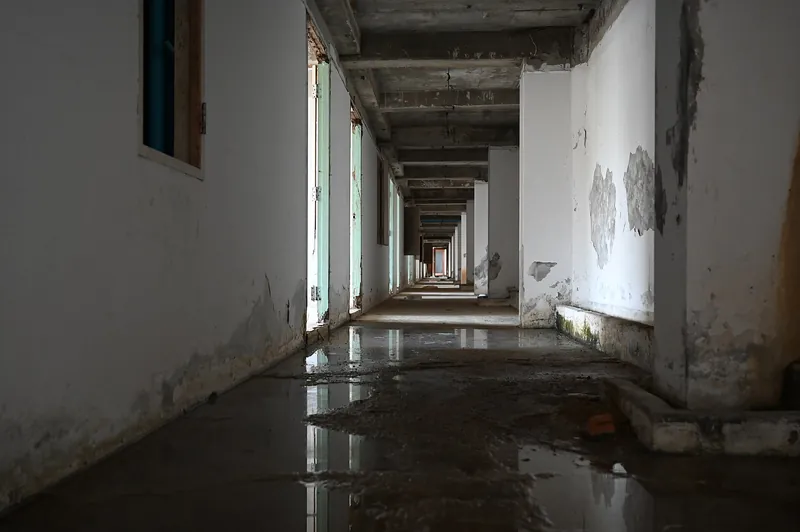

Most North Texas houses sit on concrete slabs, so there is rarely a lower level to hide a problem. The hiding places are inside the walls, under flooring, in the cabinet bases and in the attic.
- Fresh paint on only the lower few feet of walls, or a new floor in one room only.
- Baseboards that are new, swollen or caulked along the top edge.
- A musty smell that returns when the air conditioner is off.
- New drywall with seams that do not match the rest of the house.
The signs of water damage guide lists clues to look for, and drywall water damage repair shows how wet walls are normally opened and dried.
What should a home inspection check in a house with water history?
Tell the inspector about the flood history before the visit and ask for a moisture meter to be used on walls, floors and cabinet bases. A visual look alone can miss damp framing behind a clean surface. Ask what the inspection does not cover, in writing.
Ask the inspector to look at the attic, the water heater, the air conditioner drain line and the roof from inside, since those are the usual leak points in a slab house. Ask whether a plumber should check for a slab leak, and whether a moisture reading can be taken at the bottom of exterior walls.
The home inspection water damage guide covers the report in more detail. If the inspector flags moisture, ask for readings, not adjectives.
Will insurance cover a flooded house I buy?
Usually not, unless you buy flood coverage. FEMA states that flood losses are generally not paid under a homeowners policy, and Triple-I explains that flood protection comes from a separate NFIP or private policy. Ask for a quote early, since a lender may want proof.
The NAIC describes a plumbing failure or roof leak as a typically covered cause of water damage, while ground water, runoff and snow-melt are not. Triple-I also notes that maintenance failures, mold and pests fall outside coverage. Unrepaired past damage can run straight into those limits.
Ask the seller whether a claim was ever filed, and ask your agent how an insurer views the address. A sewer backup is a third category: Triple-I says neither a typical homeowners policy nor flood insurance pays for it, so it needs its own endorsement. The insurance claims guide explains how claims work once you own the home.
Does mold from past water change what I can ask for?
It can. TDLR's guide says a seller must hand the buyer every certificate of mold remediation issued in the five years before the sale. If the seller had a licensed mold project, ask to see its paperwork, including what the assessor's protocol required.
TDLR adds that the assessment license holder gives the owner that certificate within 10 days after the work ends, and that projects under 25 contiguous square feet are exempt. A small patch can be cleaned without a licensed project, so a missing certificate does not prove there was no mold.
Per the EPA, anything water-damaged should be dry inside the first 24 to 48 hours so mold does not take hold, with indoor humidity held below 60 percent. If the history suggests a slow dry-out, ask for readings now. Then read mold after water damage.
How much can water damage cost after I close?
Insurance data gives a sense of scale, not a quote. The Insurance Information Institute reports that the average claim for water damage and freezing was $15,400 for 2019 to 2023, and that about one in 60 insured homes files such a claim each year. Your house could cost less or far more.
Restoration cost depends on the water category, the area, the materials and how long the water sat. Providers set their own prices, so compare written, itemized estimates. The water damage restoration cost guide lists published national ranges with their sources.
Use the number as a reason to negotiate or to walk away. Ask your agent whether a repair credit, a price change or a longer option period fits the contract.
What if I find damage after I move in?
Stop the source, take photos, and contact your insurer and the seller's agent before major repairs. Triple-I's advice is to prevent further damage but wait for the adjuster before any big permanent repair. Save every receipt, because reimbursement and any dispute with the seller may both depend on them.
- Photograph and video the damage before anything is moved.
- Shut off the water if a supply line is the source.
- Call your insurer and ask about the deadlines that apply to your claim.
- Review your inspection report and the disclosure notice for anything that was flagged or left out.
- Talk to a real estate attorney about what the contract and Texas law allow.
- Get a provider to dry it so the damage does not grow while the claim runs.
TDI's consumer page gives an insurer 15 business days to acknowledge a claim, then 15 more business days after it has what it asked for to accept or deny it. Details are in the TDI claim steps.
When should I call a restoration provider?
Call as soon as you find active water, a wet wall or a musty room, and before repairs close the area up. Providers differ in what they handle, so ask directly what is dried, what is removed and what readings you get. This site connects you with independent providers and ranks none.
- Ask the provider to explain the water category and why.
- Ask for a written scope you can show your insurer.
- Ask who handles plumbing and mold work, since those are licensed trades in Texas.
The guide to choosing a restoration company has a question list, and the flood cleanup page covers safety after outside water. More reading is in the Dallas water damage guides.
Sources: SB 339 (2019), seller's disclosure notice, enrolled text; TDLR mold licensing summary; TDI claim steps; FEMA flood insurance FAQ; NAIC homeowners consumer page; Triple-I on covered disasters; Triple-I on settling claims; Triple-I homeowners statistics; EPA mold and moisture guide; IICRC S500 water categories; Wikipedia, Dallas.