The short version
To keep pipes from freezing, insulate lines in attics, garages and exterior walls, drain outdoor hoses, open cabinet doors, let a faucet drip and keep the thermostat steady day and night, never below 55 F when away. The Red Cross lists these steps. Thaw with gentle heat, never an open flame.
How do I keep pipes from freezing in a Dallas house?
To keep pipes from freezing, add insulation where supply lines run through cold spaces, keep garage doors closed, open cabinet doors on exterior walls, let a faucet drip during a hard freeze, and hold the thermostat steady day and night. These steps come from the American Red Cross and cost little compared with a burst pipe.
Dallas has mild winters, so a freeze catches many households unprepared. A plan you make in October works better than one you try to build the night the forecast drops. The sections below go in the order you would do the work: find the weak spots, protect them, then handle the cold snap itself.
If a pipe has already split, skip ahead to the burst pipe water damage page. For what happened across North Texas in 2021, read the winter storm pipe damage page.
Which pipes in a North Texas home freeze first?
The Red Cross names three groups: pipes exposed to severe cold, supply pipes in unheated interior spaces, and pipes along exterior walls with little insulation. In a slab house that usually means hose bibs, sprinkler lines, attic runs, garage lines and kitchen sink cabinets.
| Spot | Why it is exposed | What the Red Cross suggests |
|---|---|---|
| Outdoor hose bibs and sprinkler lines | Open to the weather | Drain hoses, close the inside valve, leave the outside bib open |
| Attic supply lines | Unheated space above the ceiling | Add insulation to the space and wrap exposed pipes |
| Garage lines and water heater feeds | Often no heat, a large door | Keep the garage door closed |
| Pipes in exterior walls | Little or no insulation between pipe and outdoors | Open cabinet doors to let warm air reach them |
| Kitchen and bath cabinets | Closed doors trap cold air against the wall | Insulate hot and cold lines in these spots |
Walk the house with a flashlight and note every place a line enters an attic, garage or outside wall. The signs of water damage guide helps you spot an existing leak while you are looking.
What should I do before a freeze is forecast?
Start with the shutoff and the outdoor lines: find your main valve, drain and store the hoses, and protect any pipe that is exposed to cold. Then confirm that your heating works before the cold arrives. The checklist below fits into one afternoon.
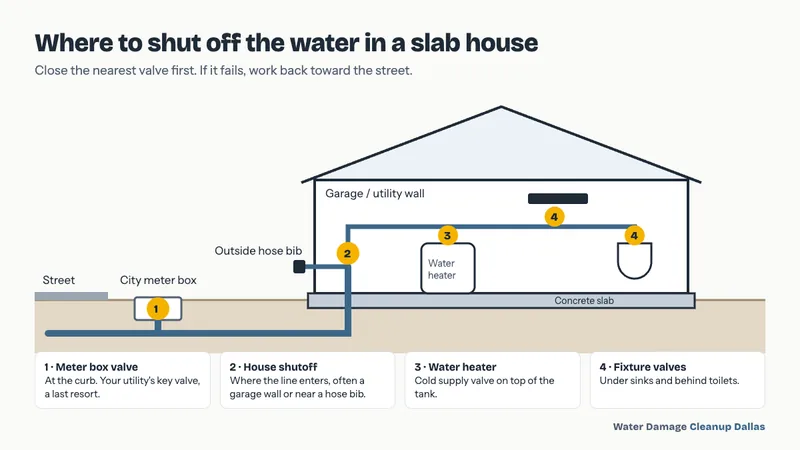
- Locate and test the main valve. You need to reach it in the dark and turn it by hand.
- Remove and drain outdoor hoses. Close the inside valve to each hose bib and leave the outside bib open, as the Red Cross describes.
- Drain sprinkler and pool supply lines using the manufacturer's or installer's directions. The Red Cross says not to put antifreeze in them unless directed.
- Insulate exposed lines with a pipe sleeve, or ask a plumber about UL-listed heat tape or heat cable for runs that stay exposed.
- Close the garage door if water lines run through it.
- Move cleaners out of reach before you open cabinet doors, since children and pets can get into them.
Pipe sleeves are sold at hardware stores. Heat tape is an electrical product, so follow its instructions and ask a professional if you are unsure about installing it.
Should I let my faucets drip during a hard freeze?
Yes, for faucets served by exposed pipes. The Red Cross says that when it is very cold outside, letting cold water drip from the faucet helps because running water, even a trickle, helps prevent pipes from freezing. Pick the fixtures at the end of lines that cross cold spaces.
A drip also relieves pressure. The burst pipe page shows how pressure builds between an ice blockage and a closed faucet.
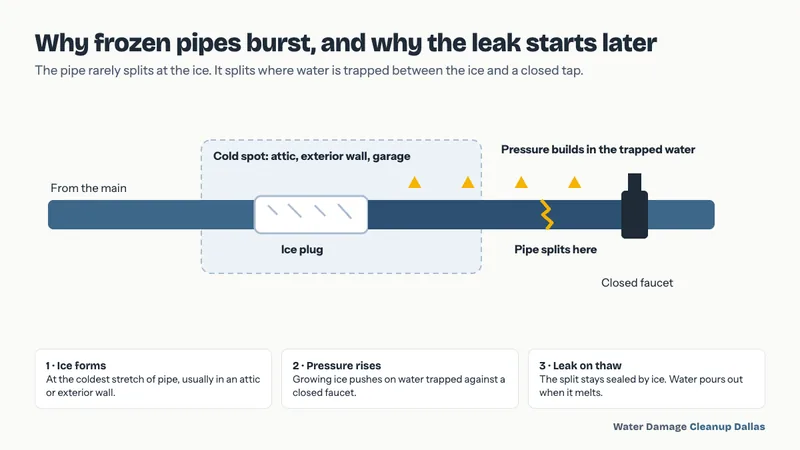
- Cold water, not hot: the Red Cross advice names the cold water faucet.
- Exposed lines first: pick the sink or tub on an exterior wall or on a line that crosses an attic or garage.
- Mind the drain: make sure the sink drains freely so a trickle does not overflow it.
- Ask your utility how a long drip affects your bill. Dallas Water Utilities customer service is listed on the city's water page.
What thermostat setting protects the plumbing?
Keep the thermostat at the same temperature day and night during a freeze. The Red Cross says to suspend lower nighttime settings, which may raise the heating bill but can prevent a much costlier repair. If you leave town, keep the heat on and set no lower than 55 F.
That 55 F figure is a floor, not a target for a house you live in. Pipes in an attic or an exterior wall can still freeze if the home itself stays warm, because they sit in a colder space than the living area.
- Before you travel: ask someone to check the house during a freeze, and leave faucets on exposed lines dripping.
- Check the furnace before winter, so heat does not fail when the cold arrives.
- Power outages: heat may stop with them. The 2021 storm page covers what that meant for North Texas.
How often does Dallas freeze enough to matter?
Often enough to plan for. The National Weather Service says DFW Airport averages 29.2 days a year with a low at or below 32 F, spread across several months. January has the most at 10.6 days, then December at 8.1 and February at 6.2.
The Wikipedia article on Dallas gives the average date of first frost as November 12 and the average date of last frost as March 12. Treat the weeks between as the season for the checklist above.
The hard freezes are the exception, but they are the ones that burst pipes. The NWS recorded 139 consecutive hours at or below freezing at DFW Airport from February 13 to February 19, 2021. A prolonged freeze like that hits pipes in attics and walls long after a typical overnight dip has ended.
Should I drain the pipes or shut off the water?
It depends on how long you will be away and how much cold is coming. Shutting off the main stops a break from running unchecked, and draining the lines removes water that could freeze. A plumber can walk you through the sequence for your house and water heater.
The Red Cross guidance for trips is to keep the heat on at 55 F or higher, rather than to drain the house. If you do shut off the main, open a low faucet to drain the lines, and ask a plumber how to handle the water heater so it does not run dry or leak.
- Shutting the main limits what a split pipe can release.
- Leaving the heat on keeps interior pipes above freezing.
- Both together is a question for your plumber if you will be gone a long time.
Appliance lines, such as the washer hoses, can fail at any time of year. See the appliance leak page and the prevention guide for the rest of the house.
How do I thaw a frozen pipe safely?
Open the faucet, then apply gentle heat to the frozen section. The Red Cross lists an electric heating pad wrapped around the pipe, a hair dryer, a portable space heater kept away from flammables, or towels soaked in hot water. Never use a blowtorch, kerosene or propane heater, charcoal stove or other open flame.
- Suspect a freeze if a faucet gives only a trickle. Likely spots are exterior walls and where the water line enters the house through the foundation.
- Keep the faucet open so water can flow as the ice melts, which also helps melt it.
- Apply gentle heat with one of the methods above until full water pressure returns.
- Check every other faucet, since the Red Cross says that if one pipe freezes, others may too.
- Call a plumber if you cannot find the frozen spot, cannot reach it, or cannot thaw it.
Watch for wet spots as the ice melts. A pipe can split while frozen and only leak once water flows. If you see water, close the main and go to the burst pipe page.
Does homeowners insurance cover frozen pipe damage?
Often it covers the resulting water damage. Triple-I lists freezing of plumbing, heating and air conditioning systems among the named perils on standard forms, but also says policies do not cover damage from lack of maintenance. Read your policy and ask your insurer what it expects of you during a freeze.
The Texas Department of Insurance reported that Winter Storm Uri produced 511,473 insurance claims and about $11.5 billion in expected insured Texas losses as of June 30, 2022. For residential property policies, the average incurred loss was about $17,800. Those are statewide numbers, not a Dallas average.
- Keep receipts for heat, pipe wrap and temporary repairs.
- Photograph the damage before you clean up.
- Hold off on permanent repairs until the adjuster has assessed the damage, as Triple-I advises.
The insurance claims guide covers the steps, and the guide to choosing a restoration company helps when the pipe has already burst. This site is a referral service, so confirm what any provider offers directly.
Sources: Red Cross frozen pipes page; NWS DFW normals; NWS February 2021 winter event; Wikipedia, Dallas; TDI Winter Storm Uri losses report; Triple-I covered perils; Triple-I claim settling; Dallas Water Utilities.