The short version
Drywall water damage repair in Dallas starts with stopping the source and photographing the wall. Firm, surface-damp board can sometimes dry in place, while soft or stained-through board is cut out. Dry the cavity before new board goes in, and never paint over damp or moldy drywall.
What should you do first when drywall gets wet in Dallas?
Stop the water, keep people and power away from the wet wall, and take photos. Drywall drinks up moisture fast, so the first hours decide whether the panel can be saved. Then work out where the water came from, because a wall rarely gets wet on its own.
- Find and stop the source: shut the house water valve for a supply line, or have a roofer cover a roof opening.
- Turn off power to the room if water is near outlets or switches, and only if you can reach the panel while standing dry.
- Photograph and film the wall, the stain edges and the floor below, with a date.
- Move furniture and belongings away from the wall so air can reach it.
- Do not paint, caulk or seal a wall that is still damp.
- Call your insurer, then request a restoration provider if the wall feels soft or the water spread.
The emergency water damage restoration page shows what happens next. This page covers the repair decisions for walls, and the wider rebuild sits in the water damage repair guide.
What happens if drywall gets rained on or soaked?
Drywall is a paper-faced gypsum board, and paper and gypsum both soak up water. A brief wetting may leave a stain and a rippled surface that dries flat. A long or repeated soaking softens the board, loosens the joint tape and invites mold on the paper face.
The same thing applies to rain that gets in through a damaged roof, a failed window seal or a wall that was never closed in. Here is how the common cases tend to go.
| What you see | Usual call | Why |
|---|---|---|
| Light stain, board still firm | Often dried in place | Surface moisture may leave once the source stops |
| Bubbling or peeling paint | Check with a meter first | Moisture may be sitting behind the paint film |
| Soft or crumbling board | Cut out and replace | The gypsum core has lost its strength |
| Sagging ceiling panel | Remove it, after draining safely | Water is pooled behind the surface |
| Dark spots or a musty smell | Treat as mold until proven otherwise | Mold can grow on wet paper facing |
| Soaked by outside flood water | Usually removed | Category 3 water contaminates porous materials |
The IICRC S500 defines Category 3 as grossly contaminated, including rising flood water and outside surface water. Drywall that absorbed it is generally cut out instead of dried. The ceiling water damage guide covers draining a bulging ceiling.
Can wet drywall be dried, or does it have to be replaced?
Both happen. Panels that are damp on the surface and still firm can sometimes be dried with air movers and dehumidifiers. Panels that have gone soft, swollen or stained through to the back are normally removed, and a provider decides by taking moisture readings.
Time pushes the decision. EPA guidance sets 24 to 48 hours as the drying target, and the CDC names the same window after a flood. After that, mold becomes the main worry and the odds of saving a panel drop.
Insulation and the wall cavity matter as much as the board. Water can hide behind a panel that looks fine, which is why cavity readings come before any closing up. Providers differ in how they test, so ask which meters they use and where they take readings.
How is water-damaged drywall repaired step by step?
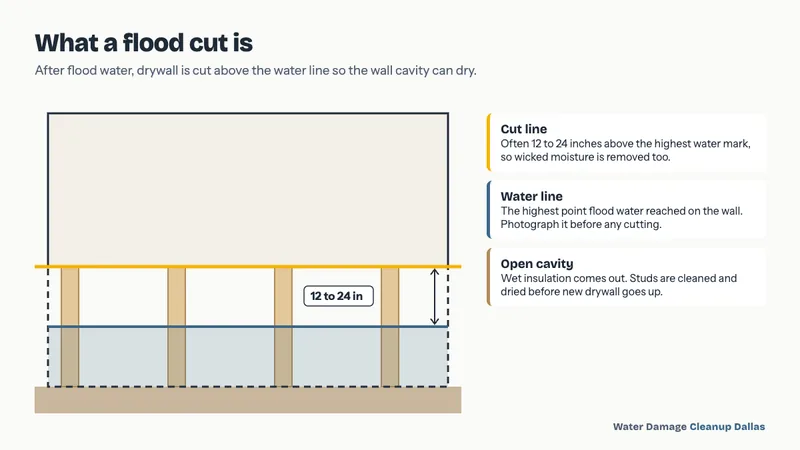
The wet section comes out, the cavity dries, and new board goes in. A flood cut takes the board off above the water line so the studs and insulation are exposed. Only after dry readings do patching, taping and finishing begin.
- Mark the cut line above the visible water mark, since moisture often wicks higher than it shows.
- Cut and remove the wet board, then pull wet insulation out of the cavity.
- Dry the studs and bottom plate with air movers and dehumidifiers.
- Confirm dry readings before anything is closed up.
- Hang new board, tape the joints and apply joint compound in coats.
- Prime and paint the repaired area, often the whole wall so the color matches.
Each coat of joint compound dries before the next goes on, so finishing alone takes several visits. A homeowner with the right tools can patch a small panel. A larger area, a wet cavity or a suspected mold problem is a job to hand to a contractor, and the structural drying guide covers the drying stage.
Do restoration companies replace drywall?
Some do, and some only remove it. Many restoration providers cut out wet drywall as part of drying, then leave the new board, tape, texture and paint to a general contractor or a drywall finisher. Others handle the whole job, so there is no rule you can count on.
This site is a referral service. It does not do the work, and it cannot say what a given provider offers. Ask each one plainly.
- Do you remove the wet drywall, and do you also hang and finish new board?
- Who matches the texture and paint, and is that in the same estimate?
- Is demolition priced apart from the rebuild?
- Will you leave the cavity dry, with readings I can see?
Our guide to choosing a restoration company has more first-call questions, and the work authorization guide explains what to read before you sign.
Can you paint or mud over water-damaged drywall?
Not while it is wet, and never over mold. The EPA says not to paint or caulk moldy surfaces. Paint and joint compound over damp board seal the moisture in, and the stain or bubbling usually returns through the new finish.
Stain-blocking primer covers a dry stain, not a wet wall. The sequence is source fixed, board dry, readings confirmed, then finish. A small mark on a dry panel can be primed and painted, which is a fair homeowner job.
If the stain keeps coming back after the leak has stopped, the moisture is still there or the source was missed. Go back to the roof, the attic AC drain line, the plumbing wall or the window above, and check the cavity again before more paint goes on.
How do you repair a water-damaged exterior wall or stucco?
Dry the wall from the inside, then fix whatever let the water in. Exterior walls get wet through failed window seals, cracked siding or stucco, flashing and roof edges, so the outside repair is about stopping entry. The inside repair is the same flood cut and drying as any other wall.
Exterior paint that got wet is a separate question. Fresh paint can blister or wash off if rain hits before it cures, and an old finish may peel where moisture is trapped. A dry surface can be scraped, primed and repainted, but peeling that returns points to water behind the wall.
- Look for stains on the inside of the wall under a window or at a roof edge.
- Check caulk and flashing around openings after a storm.
- Keep gutters and downspouts clear so water does not run down the wall.
- Stucco and siding repair is a separate trade from drying.
The gutters and downspouts guide and the roof leak and storm damage guide cover the most common entry points.
Why does drywall get wet in Dallas homes?
Hail, freezing pipes and summer AC leaks are the common routes into a Dallas wall. Texas ranked first with 902 major hail events in 2025, per Triple-I. Hail opens roofs, and rain follows into the attic insulation and then the ceiling drywall.
Winter is the other driver. The National Weather Service says DFW Airport stayed at or below freezing for 139 consecutive hours in February 2021. The Red Cross names attics, garages and kitchen cabinets as the spots where supply pipes face the most risk, so walls next to them can soak when a split pipe thaws.
In summer the culprit is often an air handler in the attic. A clogged condensate line can overflow the pan, and the water soaks the ceiling drywall below. The AC leak guide shows how it happens.
Most North Texas homes sit on concrete slabs, so water from a pipe, appliance or flood often spreads across the floor and wicks up the bottom of the walls. Check baseboards and the lowest few inches of the board first. The hail storm and roof leaks guide covers slow leaks that hide in insulation.
What does drywall water damage repair cost, and will insurance pay?
Costs vary, and this site does not quote what a provider will charge. For national scale, Fixr and Bob Vila both quote drywall at $1.50 to $3 per square foot, and Bob Vila prices ceiling repair at $350 to $1,250. These are national guides, not Dallas bids.
Insurance depends on the source of the water. The NAIC describes plumbing failures and roof leaks as the usual covered causes, with ground water, runoff and snow-melt left out. Triple-I adds that neglected maintenance and mold are not paid for, and the NAIC notes that mold cost is often excluded.
Flood is the major exception. Flooding sits outside most homeowners policies, FEMA says, and Triple-I explains that cover comes from a separate NFIP or private policy. On the claim clock, the Texas Department of Insurance gives a company 15 business days to acknowledge and requires written reasons for a denial.
Itemized bids that list materials and prices make the numbers easier to compare. The restoration cost guide and the insurance claims guide go deeper on each.
When is mold on a wall a DIY cleanup?
Small patches on hard surfaces are often a homeowner job, and large or hidden growth is not. For a patch under about 10 square feet, roughly 3 ft by 3 ft, the EPA says most people can do the cleanup themselves. Texas regulators draw a separate line for licensing.
The Texas Department of Licensing and Regulation says visible mold under 25 contiguous square feet can in most instances be cleaned by unlicensed people. It also notes that mold from sewage or other contaminated water needs a professional, a point the EPA makes too. Mold inside a wall cavity is hard to size by eye.
For hard surfaces, the CDC suggests household cleaner, soap and water, or at most 1 cup of bleach per gallon of water, never combined with ammonia or other cleaners. It also calls for boots, gloves, goggles and open windows. If you are unsure, or anyone in the home has asthma, call a professional.


The mold after water damage guide goes through when to hire help. If wet drywall is spreading, reach out through this site and we will pass your request to an independent restoration provider that takes requests for your area.
Sources: TDLR mold FAQ; EPA guidance on cleaning up mold; EPA brief guide to mold and moisture; CDC page on mold and health; IICRC S500 water categories; Triple-I hail statistics; NWS Fort Worth on the February 2021 storm; Red Cross frozen pipes page; Bob Vila restoration cost article; Fixr restoration cost guide; TDI claim payment steps; FEMA flood insurance FAQ; NAIC homeowners insurance page; Triple-I on covered disasters; Triple-I on settling claims.