The short version
For ceiling water damage repair in Dallas, turn off power to the room, put a bucket under the lowest point and drain any bulge on purpose. Then trace the source: roof, AC drain, water heater or a pipe. Dry the area in the first 24 to 48 hours, and expect sagging or contaminated board to come out.
What should I do first when water is coming through my ceiling?
Keep everyone out from under the bulge, switch off power to that room at the breaker panel, and set a bucket below the lowest point. Then close whatever valve feeds the leak, if you can name it. Take photos before anything gets moved.
- Cut the circuit for the room, and for any light fixture that is dripping. Do not reach the panel by wading through water.
- Move furniture and rugs out of the drip zone, and cover what cannot move with plastic.
- Drain a bulge on purpose. Water trapped in a sagging ceiling will come down on its own, so release it where you choose. The diagram below shows how.
- Shut off the supply if a pipe or fixture upstairs or in the attic is the suspect. The burst pipe page covers shutoff points.
- Photograph and video the stain, the room and any damaged belongings for your insurer.
- Start air moving with a fan pointed at the area, but keep it away from the sagging section.

Is a sagging ceiling about to fall?
It can be. A ceiling that bulges, droops, cracks along the seams or feels soft has absorbed a lot of water, and wet drywall gets heavy and weak. Treat any visible sag as unsafe until the water is out and a provider has looked at it.
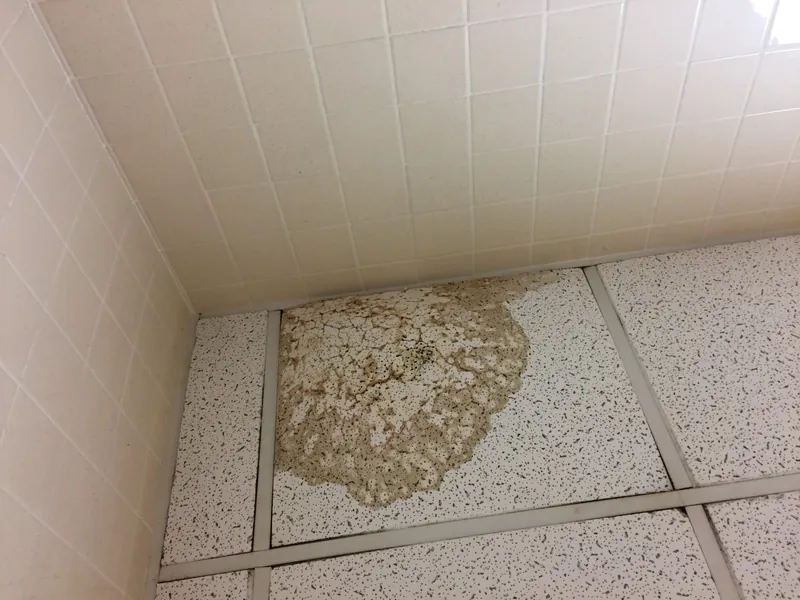
- A visible belly or bulge in the middle of a panel, often with a brown ring.
- Drywall seams opening or tape peeling away.
- Water dripping steadily from a crack or a light fixture.
- Cracking or popping sounds from above the ceiling.
- Insulation showing through a split or hole.
Stay out of the room until the bulge is drained. If the sag is large, call a provider before you go under it with a screwdriver.
How can I tell if a ceiling stain is old or still leaking?
Feel it and watch it. A stain that is damp, cool or growing is active, while a dry, hard-edged stain may be left over from a leak that already stopped. Only a moisture meter gives a firm answer, and a provider can take that reading.
- Trace the edge in pencil and check again after rain and after the AC has run for a few hours.
- Rings inside rings usually mean the leak has wetted and dried more than once.
- A stain that bleeds through fresh paint means moisture or old staining is still in the board.
- Timing helps. A mark that appears only after storms points up at the roof; one that grows on hot afternoons points at the AC.
Painting over a stain hides it without fixing it. The EPA also says not to paint or caulk moldy surfaces.
Where is the water above my Dallas ceiling coming from?
Most ceiling leaks trace to five places: the roof, the AC drain, a water heater, a supply or drain line, or a bathroom above. The pattern of the stain and when it shows up usually narrows the list before anyone climbs into the attic.
| Likely source | Clue | Water type |
|---|---|---|
| Roof or flashing | Stain appears during or after rain or hail | Rain water; the provider decides how to classify it |
| AC drain line or pan | Grows on hot days, near a vent or hallway | Condensate; the provider decides how to classify it |
| Water heater in the attic | Wet spot under the unit, steady drip | Clean, Category 1 |
| Supply line | Constant, ignores the weather | Clean, Category 1 |
| Bathroom above or drain line | Shows up after a shower or flush | Grey or worse, Category 2 to 3 |
The IICRC S500 standard defines Category 1 as clean water from a supply line or burst pipe, and Category 2 as grey water such as a washer, dishwasher or toilet overflow without waste. The category matters because it decides what can be dried and what gets removed.
For the AC route, read about AC and condensate leaks. For an overhead water heater, see the water heater leak page.
Can an attic water heater or air handler leak through the ceiling?
Yes. Any appliance that sits above the living space can send water down through the drywall when its pan overflows or its tank fails. If your water heater or air handler is in the attic, a ceiling stain below it should send you to that equipment first.
Look for rust-colored water in the drain pan, a pan that is full or tilted, and damp insulation around the unit. A water heater that drips from its top fittings or base is a plumbing or replacement job, while an air handler that overflows usually has a clogged condensate line.
Do not go into a hot attic in summer without a break plan. Dallas averages 20.2 days a year with a high of 100 F or more, per the NWS normals for DFW Airport, and attic air runs hotter than the air outside. If the area is wet and you are unsure, leave it for a technician or a provider.
Can a Dallas hailstorm cause a ceiling leak?
Yes. Hail bruises shingles, cracks tiles and knocks flashing loose, and the water finds that gap on a later rain, sometimes weeks after the storm. A stain on the ceiling is often the first sign the roof took a hit.
The Triple-I reports that Texas ranked first in the country with 902 major hail events in 2025. The National Weather Service says the April 11, 2016 supercell hit Wylie so hard that 80 percent of homes there were affected and damage topped $300 million.
After a storm, check the ceilings under the sides of the roof that faced the wind. A tarp is a short-term fix; the hail and roof leak page and the storm roof leak page walk through what to document. Wylie, covered on the Allen and Wylie page, took the worst of that 2016 storm.
Will my ceiling survive, or does it need replacing?
Sometimes. Board that took a brief soaking from clean water and was dried fast can stay. The EPA's mold guidance gives a target of 24 to 48 hours to get wet materials dry, and a ceiling that has not sagged or softened has the best chance.
- Good odds: a light stain, firm board, clean water, fast drying and a leak that has been fixed.
- Poor odds: sagging, soft or crumbling board, grey or black water, or board that stayed wet for days.
- Insulation above is judged separately. Matted fiberglass that holds water is usually pulled out.
A provider checks the ceiling and the attic space with a moisture meter. Ask what the readings were before and after drying, and keep a copy for your claim file.
At what point is the drywall too far gone?
Board gets cut out when it has physically failed, when dirty water soaked it, or when drying cannot reach the moisture inside. Gypsum with a paper face that has drooped rarely flattens again, and leaving it risks mold in the cavity above.
| Condition | Often dried in place | Usually removed |
|---|---|---|
| Drywall panel | Flat, firm, clean-water stain | Bulged, soft, split at seams |
| Attic insulation | Slightly damp, not compressed | Saturated, matted or stained by grey water |
| Joists and framing | Dried with air and heat | Soft or dark and still wet after drying |
| Texture and paint | Dry board, leak repaired | Bubbled or peeling over wet board |
Walls follow the same logic, covered on the drywall water damage page. A ceiling just adds gravity to the problem.
How do I repair a popcorn or textured ceiling after a leak?
Dry it first, then patch. A stain on a textured ceiling cannot be repaired until the board behind it is dry, and the leak must be fixed before any new paint goes up. Skip the cover-up until the meter says the area is dry.
Small spots on a sprayed or popcorn finish seldom blend in, so painters often re-texture the whole ceiling or at least a full section. A stain-blocking primer is common on brown rings. Plaster ceilings, where a home has them, dry slowly and need a plasterer rather than a drywall patch.
Repairs after the drying stage belong to a contractor, and not every restoration provider rebuilds. Ask who handles the finish work before you sign anything, and read the work authorization page first. For the bigger picture of drying followed by rebuilding, start at water damage repair in Dallas.
How likely is mold after a ceiling leak?
It can, if the ceiling and attic stay damp, because mold feeds on wet drywall paper and insulation. The EPA points to the first 24 to 48 hours as the window for getting wet areas dry, and wants indoor humidity kept under 60 percent, ideally 30 to 50 percent.
Dark spots along the ceiling edge, a musty smell, or a stain that stays damp are signs to act. According to the CDC, mold exposure can bring a stuffy nose, sore throat, cough, wheeze or burning eyes. People with asthma or a mold allergy may react severely.
For a moldy patch smaller than about 10 square feet (roughly 3 ft by 3 ft), the EPA says you can usually do the cleanup yourself. Anything bigger calls for help. The mold guide covers the details.
Will my Texas homeowners policy pay for a wet ceiling?
Often, when the cause is sudden. A leak in the plumbing or the roof is typically covered, the NAIC says, but ground water and rain runoff are not. Your own policy wording decides, so read it or ask your agent.
- Standard forms name accidental discharge or overflow from plumbing, heating, air conditioning or an appliance as a covered peril, per the Triple-I.
- Damage from neglected maintenance is not covered, and mold cleanup is often excluded.
- Per the Texas Department of Insurance, the insurer has 15 business days to acknowledge a claim, then must pay inside five business days after agreeing to.
Take reasonable steps to prevent further damage, but wait on permanent repairs until the adjuster has seen the ceiling, the Triple-I advises. Keep receipts and photos. For the full process, see water damage insurance claims.
How much does ceiling water damage repair cost?
Bob Vila, citing Angi and HomeAdvisor, puts ceiling repair at $350 to $1,250 nationally, and Fixr lists drywall restoration at $1.50 to $3 per square foot. Those are national figures, not Dallas quotes, and a provider will price your job after inspecting it.
Cost climbs when the drywall has to come down, when insulation is soaked, or when the leak spread across several rooms. It also climbs when the source needs a plumber or a roofer first. For scale, the Triple-I's average water damage and freezing claim was $15,400 across 2019 to 2023.
Ask for written, itemized bids, which the Triple-I recommends, and compare them line by line. The restoration cost guide breaks the numbers down further.
When should I call a restoration provider for a ceiling leak?
Call when the ceiling sags, when the leak came from a dirty source, when more than one room is wet, or when you cannot find the source. A provider dries the structure; a plumber, roofer or HVAC technician fixes the source.
- Stop the source with a trade you trust, or shut off the supply yourself.
- Describe the water to the provider: clean, grey or sewage, and how long it ran.
- Ask for moisture readings before and after drying.
- Confirm who does the rebuild and how it is billed.
- Read the paperwork before you sign. Our page on choosing a restoration company has a checklist.
This site connects callers with independent providers and does no restoration work itself. Providers differ in what they offer and when they can come, so confirm directly.
Sources: EPA mold and moisture brief guide; EPA mold cleanup page; IICRC S500 water categories; CDC mold and health; NAIC homeowners consumer page; Triple-I covered disasters; Triple-I claims after a disaster; Triple-I homeowners statistics; Triple-I, Facts + Statistics: Hail; NWS Fort Worth/Dallas, DFW Records and Normals; NWS Fort Worth, April 11, 2016 Hail Storm; TDI claim payment steps; Bob Vila cost article; Fixr cost guide