The short version
Look for stains, bubbling paint, warped floors, a musty smell and a rising water bill, then check for soft spots and a moving meter. Stop the water, photograph everything and ask a provider for moisture readings. EPA guidance puts the drying window at 24 to 48 hours.
What are the signs of water damage in a house?
The common signs are stains on ceilings and walls, bubbling or peeling paint, warped or cupped floors, a musty smell, soft spots and a water bill that climbs for no reason. One sign can have other causes. Two or three together usually mean water is or was in the building.
Water rarely announces itself. It moves along pipes, framing and insulation, so the stain you see is often far from the leak. This guide is for owners and renters who suspect a problem and want to check before calling anyone.
- Stains that are yellow, brown or tan, often with a darker ring at the edge.
- Texture changes: paint that bubbles, peels or flakes, and drywall that feels soft or crumbly.
- Floors that cup, buckle, lift or feel spongy underfoot.
- Odor: a damp, earthy smell that comes back after cleaning.
- Utility clues: a higher water bill, a meter that moves when everything is off, or the sound of running water.
The sections below sort these clues by where you will notice them. If you find standing water, start with the emergency water damage restoration page instead.
What does water damage look like on walls and ceilings?
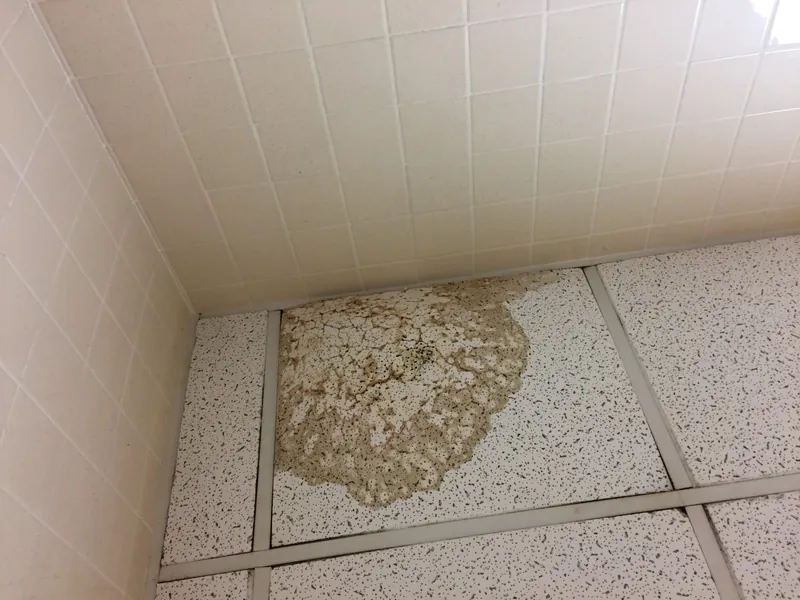
On a ceiling it looks like a tan or brown patch, sometimes with rings like a coffee spill, and on a wall it looks like a stain, a bubble in the paint or a seam that has opened. A dry stain can still be an active leak, since some only run when a fixture or the AC is in use.
| What you see | What it often means | Where to look next | Related page |
|---|---|---|---|
| Brown ring on a ceiling | A repeated leak from above: roof, attic pipe, AC pan or upstairs bathroom | Attic, air handler, room above | Ceiling water damage |
| Bulging ceiling or wall | Water trapped behind drywall | The lowest point of the bulge | Drywall damage |
| Peeling or bubbling paint | Moisture pushing out from behind the surface | Outer walls, bathroom walls, window corners | Roof leaks |
| Stain near a window | Failed seal, flashing or caulk after a storm | Window frame, sill, exterior caulk | Hail and roof leaks |
| Dark spots in a corner | Condensation or a slow leak; possible mold | Where two walls and the ceiling meet | Mold guide |
A stain is only the surface. Press on it with a gloved finger: if it feels soft, cool or damp, the material behind it is wet.
How do floors show water damage?
Floors show it by cupping, buckling, staining, lifting at the seams or feeling soft. Wood and laminate swell when they absorb water, and tile floors give clues through loose tiles and discolored grout. Carpet can look fine while the pad underneath holds water.
In a house built on a concrete slab, water often moves across the slab and shows up at the baseboard or under the flooring far from its source. A warm spot on the floor or a hollow sound can point to a leak beneath it, which the slab leak page explains.

- Hardwood: edges that rise higher than the center (cupping) or boards that lift off the subfloor.
- Laminate: swollen seams and planks that no longer lie flat.
- Carpet: a damp feel, a sour smell or a pad that squishes. See wet carpet drying.
- Tile: loose or hollow-sounding tiles and grout that stays dark.
For repair options after drying, read water damaged floor repair.
Can my water bill show a hidden leak?
Yes, a bill that rises without a change in how you live is one of the earliest warnings. A running toilet, a dripping line or a leak under the slab can waste water for weeks before any stain appears. Compare several months of bills, not just last month.
The meter can confirm what the bill suggests. With every tap, appliance and irrigation system off, read the dial, wait, and read it again. If it moved, water is escaping somewhere. The water meter leak test lays out the steps.
Dallas Water Utilities says its crews repaired 377 service line leaks in a recent three-month stretch, and that dry expansive soil and high demand contribute to breaks, according to the city's water main update. Not every leak is on your side of the meter. To report a main or street leak, call 3-1-1.
What smells and sounds point to hidden water?
A damp, earthy or sour smell means something is wet, even if you cannot find it. Sounds matter too: hissing or trickling inside a wall when nothing is running points to a pressurized line. Both clues often show up before any stain does.
Smell is covered in its own guide. Water damage smell matches common odors to likely sources, such as an attic air handler, soaked carpet pad or a wall cavity.
- Musty odor in one room: check the walls, flooring and the ceiling above.
- Musty odor when the AC runs: check the condensate line and pan. See AC leak water damage.
- Hissing or running water: shut the main valve and see whether the sound stops.
- Gurgling drains: can point to a blocked line. See sewage backup cleanup.
What causes hidden water damage in Dallas homes?
North Texas weather does most of the work: hail and wind-driven storms, hard freezes, summer air conditioning and heavy rain. Add attic and garage water heaters and appliance lines, and water has many ways in. Each cause leaves a slightly different sign, so match the pattern to the season.
At DFW Airport, the National Weather Service normals list 46.5 thunderstorm days a year and 10.9 days with an inch or more of rain, plus 20.2 days a year at or above 100 F, when air conditioners run hard. Hail is part of that picture. Triple-I counted 902 major hail events in Texas in 2025, the most of any state, according to its hail statistics page.
- After hail or a storm: stains near windows, roof lines and ceilings. See hail and roof leaks.
- After a freeze: wet walls and ceilings that show up on the thaw. DFW spent 139 consecutive hours at or below freezing in February 2021, per the NWS. See winter storm pipe damage.
- In summer: ceiling stains under an attic air handler, from a clogged drain line.
- Year round: slow appliance leaks. See appliance leak damage.
How can I tell if water damage is old or still active?
Old damage is dry, hard and often stable, while active damage is damp, soft, growing or recurring. A stain that grows, a bubble that refills after you drain it or a smell that returns all say the source is still there. Dry rings alone do not say whether the leak was fixed.
Mark the edge of a stain with a pencil and date it. Check again after a rain, after a shower or after the AC has run all day. A stain that moves past the line is active. A stain with no change is probably old, though only a moisture reading can say that it is dry.
- Active: damp to the touch, darker after rain or use, spreading, new bubbles, musty smell.
- Old: dry and stable, no new marks, and no smell. Paint over it only after the source is confirmed fixed.
- Unsure: a provider can take readings behind the surface without opening it.
Do not paint or caulk moldy surfaces, the EPA says, so dry first and cover later. The home inspection page covers what an inspector can and cannot see.
How do moisture meters and humidity readings help?
A moisture meter reads how wet a material is without cutting it open, and a hygrometer reads humidity in the air. Together they separate a surface stain from wet framing. The EPA recommends humidity under 60 percent indoors, with 30 to 50 percent as the ideal range.
Normal humidity in Dallas is not low. The NWS normals list 66 percent annual relative humidity at DFW Airport, so a reading well above your usual baseline, or a room that stays damp after the AC runs, is a better signal than one number on one day.
A restoration provider can take readings in walls, cabinet bases and floors, and can show you where the wet area ends. Structural drying explains how readings are repeated until materials are dry. Ask any provider to share the numbers and where each was taken.
Is water damage dangerous?
It can be. Wet materials can grow mold, soaked ceilings can fall, water near outlets can shock and sewage carries germs. The danger depends on the water's source, how long it has sat and how much of the building is wet. Treat unknown water as a risk until you know where it came from.
Mold exposure can bring a skin rash, sore throat, stuffy nose, burning eyes, coughing or wheezing, the CDC notes. Asthma or a mold allergy can make reactions worse, and lung infections are possible for people with weak immune systems or chronic lung disease.
The IICRC S500 standard groups water by risk. Supply-line water is Category 1. Washer and dishwasher discharge, or a toilet overflow with no waste, is Category 2 grey water. Sewage and rising river or stream water fall under Category 3. Anything above Category 1 needs more care. If you suspect sewage, read sewage exposure and your health.
What should I do when I find signs of water damage?
Stop the water, make the area safe and collect proof, in that order. Do not wait to see whether a stain grows. A wet area found early stays small, and EPA guidance sets the drying window at the first 24 to 48 hours.
- Find and stop the source. Close the fixture valve or the main shutoff. See prevention tips for valve locations.
- Make it safe. Switch off the breaker for wet rooms, but only if the panel stands in a dry spot. Keep children and pets out of sagging rooms.
- Photograph everything, with a wide shot and a close shot of each sign, and note the date.
- Move belongings out of the wet area and run fans only after the source is stopped.
- Call the right trade: a plumber, roofer or HVAC technician for the source and a restoration provider for the water.
- Notify your insurer if the damage may be covered, and keep damaged items until the adjuster visits.
This site refers callers to independent restoration providers and does not do the work. Services and timing differ by provider, so confirm what each one will check. The guide to choosing a restoration company lists questions to ask.
Does insurance pay for hidden water damage?
Often when the cause was sudden, rarely when it built up from neglect. Triple-I lists a sudden discharge from plumbing, heating, cooling or an appliance as a covered peril, while lack of maintenance is excluded, and flood and sewer backup need separate cover.
The NAIC says a plumbing or roof leak is typically covered but ground water and rain runoff are not, and many policies exclude mold. Damage found long after a leak is harder to claim, so check early.
The Texas Department of Insurance says a company has 15 business days to acknowledge a claim and must give written reasons for a rejection. Save receipts, photograph the damage and keep damaged items until the adjuster visits. See the insurance claims guide and the CLUE report page. Insurance Information Institute figures: roughly one in 60 insured homes has a water or freezing claim yearly, averaging $15,400 across 2019 to 2023. Buyers can read buying a flooded house.
Sources: moisture, humidity and drying window, EPA, Brief Guide to Mold, Moisture and Your Home; painting and caulking over mold, EPA, Mold Cleanup in Your Home; health effects, CDC, About Mold and Your Health; water categories, IICRC S500; covered perils, Triple-I, Which disasters are covered; claim steps, Triple-I, Settling claims; claim frequency, Insurance Information Institute; hail counts, Triple-I, Facts and statistics on hail; coverage basics, NAIC; claim deadlines, Texas Department of Insurance; climate normals, NWS Fort Worth/Dallas; February 2021 freeze, NWS Fort Worth/Dallas; main and service line repairs, Dallas Water Utilities.