The short version
To prevent water damage in Dallas, protect pipes before a freeze, check the roof and gutters before storm season, keep the AC drain and appliance hoses in shape, and know where your main shutoff is. Insurers expect maintenance, so dated notes from a yearly walk-through help.
How do I prevent water damage in a Dallas home?
Prevention comes down to four habits: protect pipes before a hard freeze, keep the roof and gutters ready for storms, maintain the AC drain and appliance hoses, and know where your water shuts off. The Insurance Information Institute puts the odds at about one in 60 insured homes filing a water damage or freezing claim in a given year.
The III's homeowners statistics put average claim severity for water damage and freezing at $15,400 over 2019 to 2023, and the category made up 22.6 percent of homeowners losses in 2023. Those are national figures, but they show why small, boring checks pay off.
Maintenance also matters at claim time. Triple-I points out that a policy will not pay for damage from neglected maintenance, which stays the owner's responsibility. The sections below follow the Dallas year, starting with winter.
How do I protect pipes before a North Texas freeze?
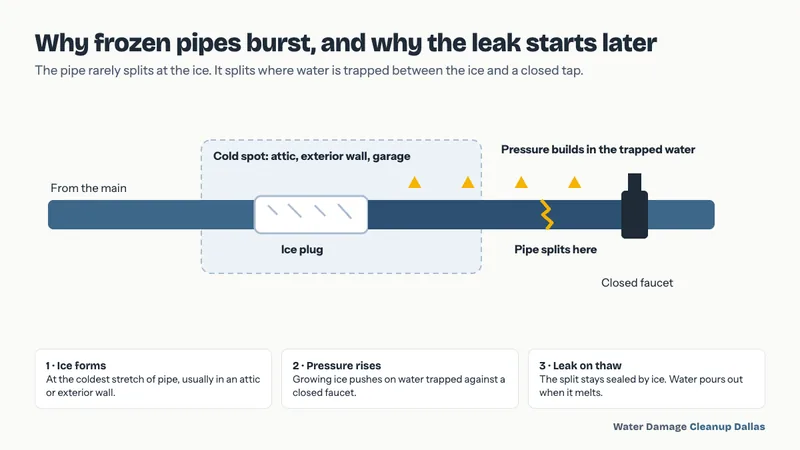
Know which pipes are exposed, keep the heat on, and let faucets drip when a hard freeze arrives. The American Red Cross says pipes most at risk are supply pipes in unheated areas such as attics, garages and kitchen cabinets. Insulate what you can reach before the first cold snap.
The Red Cross guidance for a trip in cold weather: set the heat at 55 F or higher, avoid changing the thermostat between day and night, and leave a trickle of cold water running at faucets on exposed pipes.
For a pipe that has already frozen, the Red Cross lists safe heat sources: an electric heating pad, a hair dryer, a space heater parked away from flammables, or towels soaked in hot water. It rules out any open flame, including a blowtorch, kerosene or propane heater and charcoal stove. The frozen pipe prevention topic goes deeper, and the burst pipe page covers what to do after one splits.
What did the February 2021 freeze show Dallas homeowners?
It showed that a freeze in North Texas can last long enough to defeat ordinary precautions. The National Weather Service says DFW Airport spent 139 consecutive hours at or below freezing, from 5 pm February 13 to noon February 19, 2021, and reached a low of -2 F on February 16.
The Texas Department of Insurance reported 511,473 claims and about $11.5 billion in expected insured losses statewide as of June 30, 2022. TDI says damage included freezing pipes, and that the average incurred loss was about $17,800 for residential property policies.
For a normal year, the NWS normals for DFW list 29.2 days at or below 32 F. That is why pipe protection belongs on a Dallas checklist even though snow is rare. Read the winter storm 2021 topic for what that event did to homes, and the NWS event summary for the weather record.
What should I do before hail and thunderstorm season?
Check the roof, the gutters and the places water enters, before the storms start. The NWS counts 46.5 thunderstorm days in an average year at DFW, so a roof or window flaw that survives one season gets tested again. Look for missing or lifted shingles, cracked flashing and failed sealant.
Hail is a Texas habit. Triple-I reports that Texas ranked first with 902 major hail events in 2025, and the NWS says an April 11, 2016 storm affected 80 percent of homes in Wylie, with damage over $300 million. Read the hail storm roof leaks topic for how leaks show up afterward.
Gutters carry rain away from the walls and foundation. Clear them, check that downspouts discharge away from the house, and see the gutters and downspouts topic. If a stain appears after a storm, the roof leak page explains the next steps.
How do I stop summer AC and appliance leaks?
Keep the AC drain line clear, check the pan and float switch, and replace old appliance hoses. Heat makes the AC work hard: the NWS lists an average of 20.2 days a year at or above 100 F at DFW, so a clogged condensate line has plenty of chances to overflow into an attic or ceiling.
The same habit applies to anything with a hose or a tank. If your water heater sits in the attic or garage, a drain pan and a look at the relief valve and connections are cheap checks. Washer hoses, dishwasher lines, refrigerator lines and toilet supply lines fail slowly, and a stain is often the first sign.
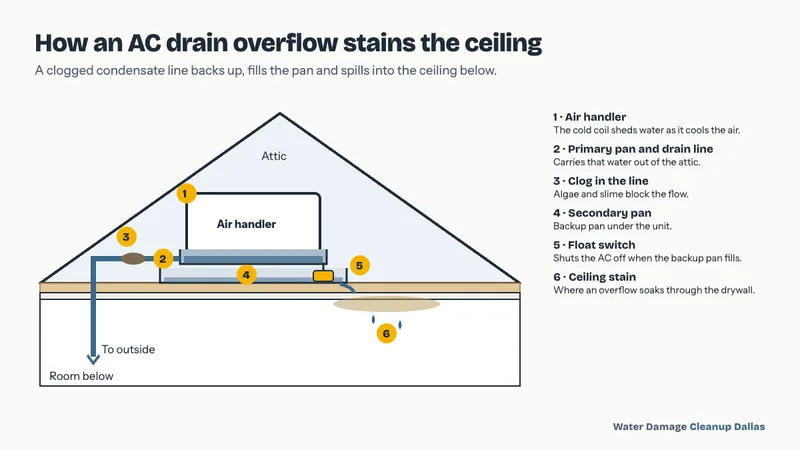
Standard homeowners forms name accidental discharge or overflow from plumbing, heating, air conditioning and household appliances as covered perils, according to Triple-I, but maintenance limits still apply. Read the AC leak page, the appliance leak page and the water heater leak page for specifics.
Where is my main water shutoff, and when do I use it?
The main shutoff is usually where the line enters the house, with a second valve at the meter box near the curb. Find both now, not during a leak. Turn the house valve a quarter turn once a year so it does not seize, and keep the path to it clear.
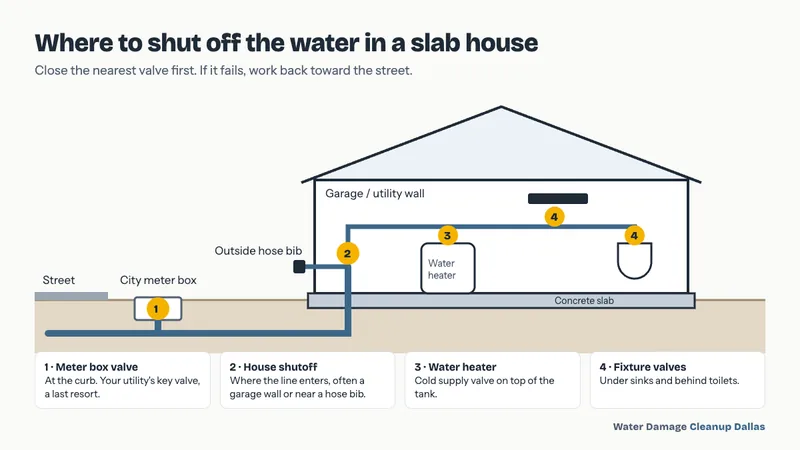
Use the shutoff when water is running and you cannot stop it at the fixture, or when you find a wet floor with no visible source. For a hidden leak, the water meter leak test topic shows how to check, and the slab leak page covers what to do if the meter keeps moving.
If the leak is on the city side, Dallas Water Utilities says to report water main leaks and breaks by calling 3-1-1, online through Dallas 311 or through the 311 mobile app. Who owns which segment of pipe is not something this site can settle, so ask the utility.
Which risk comes in which season?
Dallas water risks run through the year, and each season has a main cause. Use the table to plan your checks, and the linked pages for detail. Dates and weather vary, so treat the seasons as a guide, not a calendar.
| Season | Main risk | What to do | Read more |
|---|---|---|---|
| Winter | Pipes in attics, garages and exterior walls freeze and split | Insulate, keep heat on, drip faucets, know the shutoff | Frozen pipe prevention |
| Spring | Hail and storms damage roofs and windows; May is the wettest normal month at 4.78 inches | Inspect the roof and sealant, clear gutters | Hail and roof leaks |
| Summer | AC condensate overflow, appliance leaks | Clear the drain line, test the float switch, check hoses | AC leaks |
| Fall | Heavy rain; October is the second wettest normal month at 4.37 inches | Check grading, downspouts and low spots | Gutters and downspouts |
| All year | Water heaters, supply lines, slab leaks | Watch the bill and the meter, look for stains | Meter leak test |
What should I check every year?
Set aside an hour a year for a walk-through, ideally in early fall before the cold arrives. The list below takes in the sources of most household water losses, and each item takes minutes. Write down what you found and when, since dated notes help any later claim.
- Test the main shutoff and the valve at each toilet and sink.
- Look at the attic if it is safe to enter: air handler pan, drain line, water heater and pipe insulation.
- Inspect the roof from the ground for lifted or missing shingles, and check ceilings for new stains.
- Replace aging hoses on the washer and dishwasher and check the refrigerator line.
- Clear gutters and point downspouts away from the house.
- Check the meter with every fixture off, and compare your bill with last year's.
The signs of water damage guide lists what to look for when something is already wrong. To keep humidity in check, the EPA wants indoor air under 60 percent relative humidity, with 30 to 50 percent ideal.
Will insurance cover what prevention misses?
Sometimes, and it depends on the cause. The NAIC explains that damage from a home's own plumbing or a leaking roof is typically covered, while ground water, rain runoff and snow-melt damage is not. Flood and sewer backup are separate lines, so read your policy before the next storm.
Standard homeowners and renters policies exclude flood, Triple-I notes, and a typical policy skips sewer backups too, though that gap can be filled with a separate product or endorsement. See the insurance claims guide and the flood zone map topic.
If prevention fails, stop the water, photograph everything and call your insurer. Then use the contact page to ask for a restoration provider, and confirm with each one what it handles.
Sources: Triple-I homeowners statistics; Triple-I disaster coverage explainer; Triple-I, Facts and Statistics: Hail; American Red Cross, Frozen Pipes; NWS Fort Worth/Dallas, DFW Records and Normals; NWS, February 2021 Historic Winter Storm; NWS, April 11, 2016 Hail Storm; TDI, Winter Storm Uri losses report; EPA brief mold and moisture guide; NAIC, Homeowners Insurance; Dallas Water Utilities, water main breaks and leaks